
Marine Mammal Team Responds to a Distressed Gray Whale near Point Dume, Malibu
By Heather Henderson, Marine Mammal Program Manager
Each February through April, residents and visitors in Malibu are treated to majestic commuters –Gray Whales. From the top of Point Dume Nature Preserve trail, northbound migrating individuals and Cow/Calf pairs can be seen heading up to the nutrient rich Alaskan waters for the summer. The California continental shelf is close to the shoreline at Point Dume, allowing for large ocean animals to safely “hug” the coastline as they travel up the coast and provides an amazing wildlife viewing opportunity.
During the annual migration, our marine mammal rescue team receives calls from concerned members of the public about large whales “stuck” near the shore. In most cases, young whales approach the shallows to practice filter feeding and rub barnacles from their body on the sandy bottom. Once done, they swim out of sight to continue their lengthy journey.
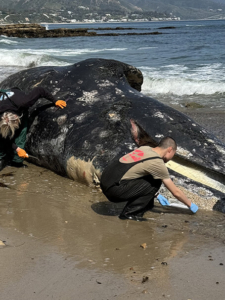
Gray Whale is examined by CWC team members.
At 9am on March 16th, 2024, we received a report that a deceased whale had come ashore at Little Dume. Upon arrival, it was determined that this 30-foot-long sub-adult male, weighing approximately 25,000 pounds (the same as seven cars), was still alive, yet in grave condition and floating at the surf line. We set up a perimeter and contacted the National Oceanic and Atmospheric Administration (NOAA) to coordinate next steps.
The top priority during any stranding event is safety! It is easy to forget the power of the ocean and sheer mass of the animal in front of you, thus we expend a lot of time and effort disseminating best practices to beachgoers while evaluating the condition of the animal. CWC is part of the West Coast Marine Mammal Stranding Network, and we work to support each other during large scale responses. Until the multi-ton whale fully beached, this was a waiting game. By 12:45pm, we confirmed that the Gray Whale was no longer alive, and was now being tossed in the shallow surf, which made approach for a full examination too dangerous. Our team remained on site until sundown and provided education to the public.
On March 17th, the whale was on wet sand and exposed by the low tide. We contacted Ocean Animal Response and Research Alliance (OARRA) to join us to examine the animal and collect samples that may help shed light on why this beautiful animal perished. During the examination we observed signs of trauma to the head of unknown origin. A ship strike may be the result of this type of trauma. Even a large whale can go unseen by an enormous vessel transporting in and out of our ports, especially as a whale surfaces from a deep dive. These incidents are not malicious, although heartbreaking.
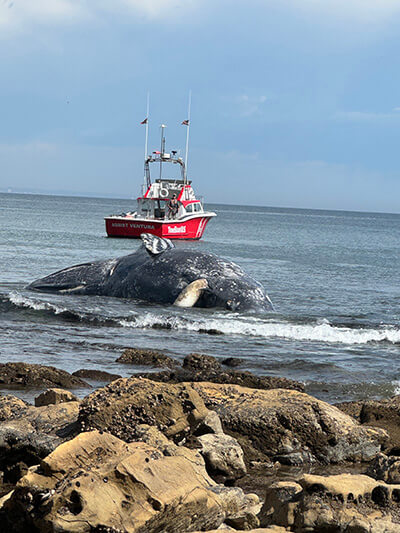
Boat waiting to tow whale offshore
It is important to note that cetaceans, like dolphins and whales, rarely strand themselves along the Southern California coastline in good health. Only permitted individuals may touch a stranded marine mammal. Others attempting to “help” is harassment and a fineable offense. In addition to being extremely dangerous, dragging a beached marine mammal back into the water is more likely to cause them harm.
When a large marine mammal strands on the beach and dies, we can leave the animal in place or tow them offshore. The latter comes at a high price and there are many logistical considerations for this option to be successful. Some of these considerations include wind and ocean currents bringing the animal back, if only towed a few miles offshore. Coordinating with NOAA, the Gray Whale was returned to the ocean where he will be a valuable source of nutrients throughout the food web.
If you witness a marine mammal in distress, please do not touch, pour water on, or allow dogs to approach. Stay back 50+ feet and report immediately, (310)924-7256.