
Rising Again: Successful Wing Fracture Repair and Flight Recovery
By Dr. Lauren Michaels, Director of Animal Care
One of California Wildlife Center’s most common patients are raptors suffering from blunt force trauma- often resulting from vehicle collisions, window strikes, or other unknown trauma. On August 22, 2025, an adult female Red-tailed Hawk (Buteo jamaicensis) was brought to the center by a good Samaritan after being found grounded and unable to fly in Los Angeles.
On admit, she exhibited a drooping left wing and dehydration. CWC’s animal care team stabilized her with subcutaneous fluids, anti-inflammatories and a wing wrap to reduce pain and movement. After rest and stabilization, her wing droop persisted, prompting the next steps- diagnostic imaging. Given that our patients do not “sit still” for their own care, she was placed under general anesthesia for full body radiographs (x-rays). We discovered a fracture of the left major and minor metacarpal bones- structures essential for flight feather attachment wing stability. Given the significance of these bones, we elected to pursue orthopedic surgery for structural support and long-term healing.
Avian bone anatomy presents unique surgical challenges, as their pneumatic (air-filled) structure makes them both lightweight and delicate. A method called external fixation was used to stabilize the broken bone. Pins were placed into the bone on either side of the fracture and connected with a lightweight bar outside the body to hold everything in place while it healed.
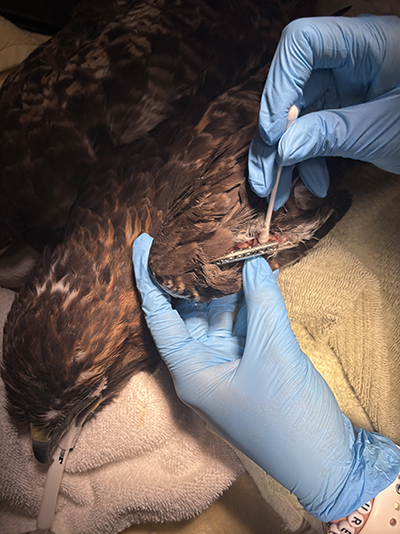
Dr. Michaels employs external fixation to stabilize the broken bone.
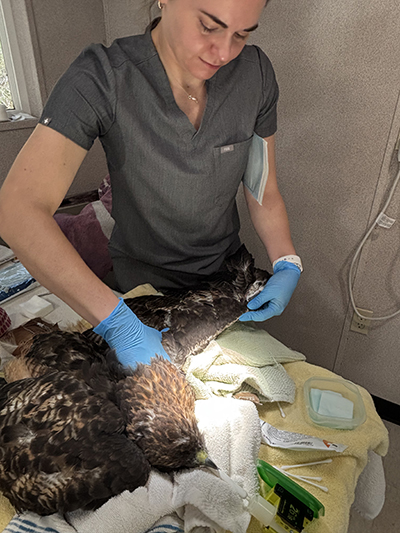
Dr. Michaels does physical therapy on the patient’s wing.
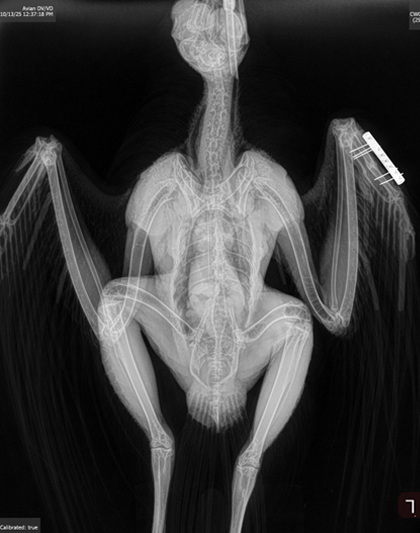
6-week post-operative radiographs of Red-tailed Hawk’s wing.
Healing takes time and patience- both for the patient and the rehabilitator. Wing fractures in large birds require roughly between four to eight weeks to heal, during which strict cage rest, physical therapy, and careful pin-site maintenance are critical. To minimize stress while maintaining mobility in the wing, this hawk received weekly physical therapy to prevent joint stiffness.
Three weeks post-surgery, follow-up radiographs showed stable alignment and early callus formation (bone regrowth), though healing was incomplete. After nearly six weeks of recovery, a final set of radiographs confirmed full fracture stabilization, and the pins were safely removed under anesthesia.
The hawk was then transferred to a small outdoor enclosure for pre-flight conditioning, and she was able to fully extend her wing freely for the first time in weeks! These intermediate enclosures are vital, offering both reduced stress and a controlled environment to rebuild muscle and bone strength after prolonged rest.
Her journey embodies the resilience of wildlife and the dedication of those who care for them. Soon, she will advance to a large flight aviary for full flight conditioning. Thanks to the skill, compassion, and resources at California Wildlife Center, this remarkable hawk’s story shows that even the most wounded can rise again.