
The Plastic Impact on Marine Life
By Tayler Lackey, Development Coordinator
As the world becomes more complex so too do the issues facing our wildlife. Plastics have become a particular concern in all areas of life but most notably in our oceans.
The CWC Marine Mammal team has seen the impact of plastic pollution in our oceans firsthand. It is not uncommon to receive a call about fishing line entanglement. At any given time, CWC is monitoring animals that have been reported to be in this situation. Sometimes these animals are difficult to reach, posing a safety risk for our team, in these cases the best we can do is oversee the situation until we can capture them and bring them in for care. With continuous oversight an opportunity may arise to attempt a rescue. When intervention is possible entanglements are often treatable, but ingestion of plastic is a challenge that is not so easily diagnosed.
Two years ago, we received a call about a Pygmy Sperm Whale who was stranded on Surfrider beach. During the postmortem examination, a plastic bag was found in the whale’s intestinal track. While the whale presented with additional issues, the plastic bag was a concerning finding.
This season we had two similar cases. The Marine Mammal response team received a call about a subadult California Sea Lion stranded on the beach. During rescue, the animal vomited, and to our team’s surprise, in the vomit was a trail mix bag. There was also the case of a female Northern Elephant Seal pup, rescued at the height of our busy season. Like many of the animals we rescue, she was malnourished and unable to thrive without medical intervention. After clearing her GI track of ingested tar, the pup was eating well and gaining weight appropriately. Unfortunately, she began to decline quickly and didn’t make it through her rehabilitative journey. During her necropsy, multiple plastic items were found in her stomach. During an exam like this, it is common to find foreign objects like small pebbles in the stomach. Starving marine animals will take to foraging on the ocean floor for whatever food they can find and may accidentally ingest nonedible objects, however the plastic items were unexpected.
While none of the deceased animals perished solely from the presence of plastic, the prevalence of these instances points to a growing problem. Additionally, we are still in the early stages of understanding how microplastics and plastic waste affects people and animals. Ingestion of a foreign body is not ideal for an animal that is already suffering from other ailments, many of which are human made- warming waters due to climate change, large scale fishing operations, oil pollution, etc. It is the hope that cases like these will serve as a call to action to our neighbors, friends, and families about the importance of reducing plastic usage and the significance of disposing of all trash correctly after visiting a public space.
If you witness a marine mammal in distress, please do not touch, pour water on, or allow dogs to approach. Stay back at least 50 feet and report immediately to our Marine Mammal team, (310)924-7256.
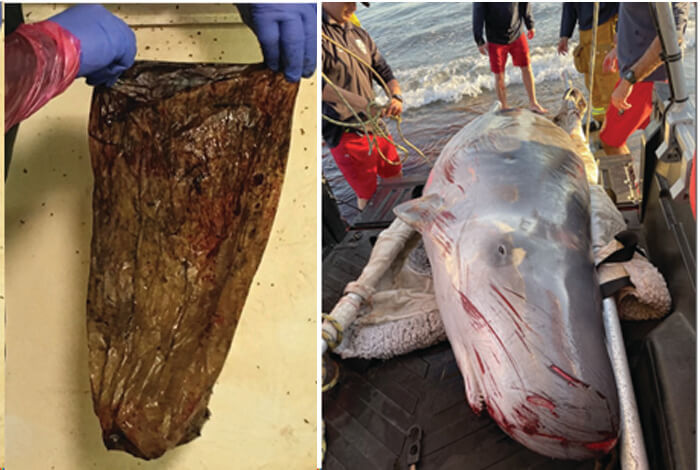
Plastic bag found in Pygmy Sperm Whale’s GI track (left). Pygmy Sperm Whale rescue (right)
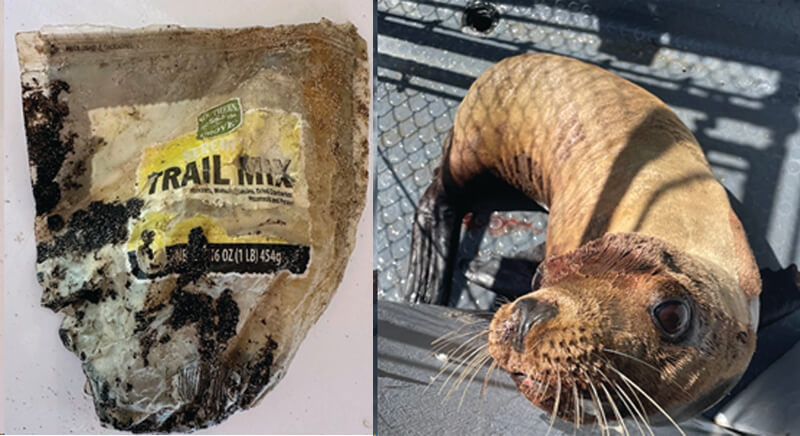
Trail Mix bag found in CA Sea Lion’s vomit (left). CA Sea Lion in care (right)
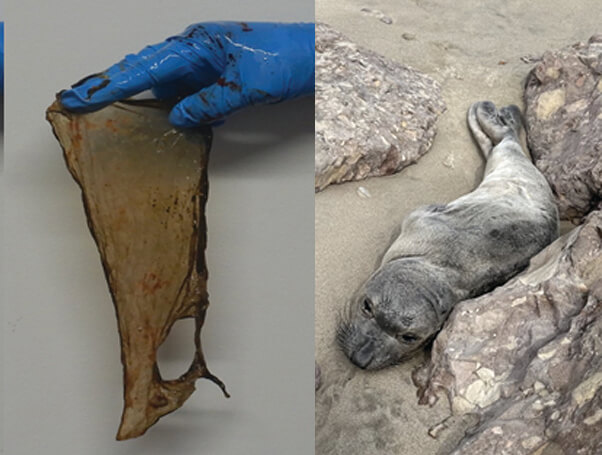
Plastic item found during Elephant Seal’s postmortem exam (left). Elephant Seal prior to rescue (right)