
Soaring to New Heights
By Kristen Kanatzar, Hospital Manager
This time of year, November through February, is referred to as our slow season, simply because we receive significantly fewer patients daily than we do during the summer months. This slow season, however, has been anything but, as we have admitted an unusually large number of birds of prey in addition to our usual caseload.
So far, we have admitted 41 hawks and 18 owls from a variety of species. By far the most common species are Red-tailed Hawks and Great Horned Owls, but we also regularly see Barn Owls, Red-shouldered Hawks, and Cooper’s Hawks. During an average slow season, we do see an increase in birds of prey, but this year seemed exceptional. In December alone, we admitted 19 hawks and 8 owls. Twelve of these hawks arrived within 15 days, nearly one hawk per day. Overall, we have cared for 30% more hawks and 38% more owls than at this time last year, though that isn’t the only reason the season feels busier.
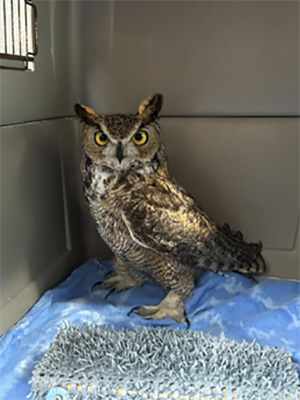
Great Horned Owl patient
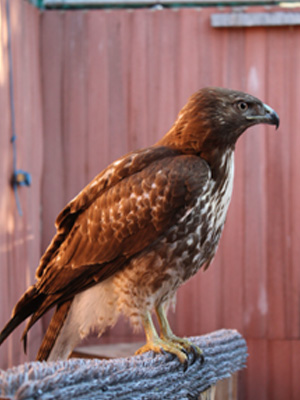
Red-tailed Hawk patient
In addition to the uptick in the number of patients, the raptors we have admitted are arriving with more serious injuries. Many hawks and owls have shown trauma typical of being hit by cars, from fractures and head injuries to wing deficits and, sometimes, eye damage. With injuries this severe, the time each patient spends in care can vary greatly, with some requiring several months to heal and recover fully.
With the increase in storms in December and January, we also saw a larger number of hawks and owls come in cold, wet, and emaciated. Many of these cold and wet birds likely came in hypothermic because their shelter became inadequate as the rain progressed. The emaciated birds may have struggled to find food or were themselves displaced due to the rain. During big storms, every animal is impacted in some way.
Although the increase in birds of prey was unexpected, we adapted and learned to manage a higher-than-usual caseload of special-needs patients. In early January, we had 18 raptors in care, more than we’ve ever had at any one time. Thankfully, our wonderful staff and volunteers worked together to ensure every patient received the best care possible, adjusting along the way, so we didn’t run out of our limited resources.
Getting to care for these incredible animals, watching them heal and overcome the injuries or illnesses that brought them to us, and finally seeing them released, is one of the most rewarding parts of this job. Even though the recent increase in birds of prey brought some unexpected challenges, it is all worth it to watch them soar back into the wild.