
• Link to Facebook
  • Link to X
  • Link to Youtube
  • Link to Instagram
  • Link to Mail
MEDICAL EMERGENCY? CALL: +1 310 458-WILD(9453)
DONATE
California Wildlife Center
  • Home
  • About Us
    • What We Do
    • Our Team
    • Education
  • Animal Resources
    • Medical Emergency
    • Co-Existing with Wildlife
    • FAQ
    • Animal Profiles
    • Gallery
  • Support Us
    • Ways to Support Us
      • Donate & Support Wildlife
      • Conservation Circle
      • Sponsor an Animal
      • Our Wish List
      • Other Ways to Give
  • Get Involved
    • Employment
    • Volunteer
      • Become a Volunteer
      • Internships
      • Externships
  • Events
  • News & Blog
    • In the News
    • Newsletters
    • Patient of the Week
    • Edison
    • From the Community
    • Videos
    • Gallery
    • Media Requests
  • Contact
  • Store
  • Click to open the search input field Click to open the search input field Search
  • Menu Menu

The Education Corner: Nests

By Cambria Wells, Education and Outreach Manager

With the arrival of Spring, CWC always alerts our neighbors to stop trimming trees and bushes unless absolutely necessary. We warn about giving space to nesting animals, particularly nesting birds. But bird nests can be hard to find. So, what are you really looking for around your home?

Cup: Cup nests are the most common nest type found around homes. The small cup nests of many backyard songbirds often include a variety of materials including grasses, small twigs, lichen, moss, animal fur, and even spiderwebs.

Suspended: Suspended nests may be cups or more elaborate, dome-shaped or sock-like structures. These are often either woven from vegetation, or are adherent structures made by combining mud and saliva.

Cavity: Some birds seek additional protection by constructing their nest within a sheltered cavity, such as the holes made by an Acorn Woodpecker.

Platform: Platform nests come in a variety of styles, but in backyard environments they are typically constructed of sturdy sticks on a flat surface. Some may be large and elaborate, like that of many hawks, and others may be thin or hastily constructed, like many doves’ nests.

Though we’ve barely scratched the surface of the diversity of nesting birds, looking out for these four nest styles will go a long way in helping to avoid disturbing a growing family. Remember to save tree trimming for November through January and give active nests their space. If you’re lucky enough to find a nest where you can safely observe it from a distance, take your time to enjoy nature at work!
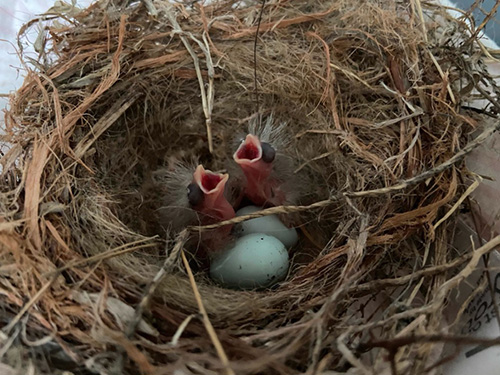
Finch nest (classic cup nest)
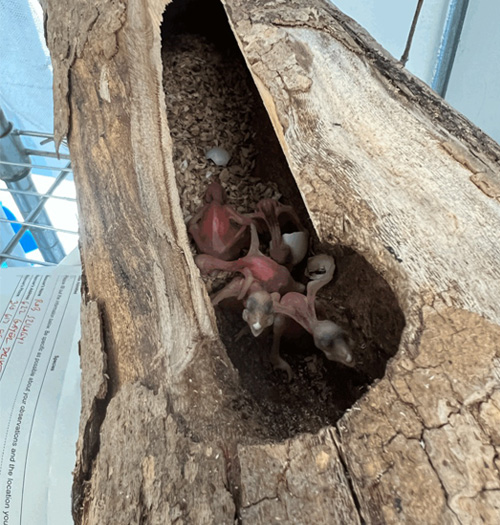
Acorn Woodpecker nest cavity (cut open by tree care workers)

LATEST POSTS

  • The Education Corner: RenestingMay 13, 2026 - 11:40 am
  • Rescuing Stranded Marine Mammals during an Outbreak of Avian InfluenzaMay 13, 2026 - 11:38 am
  • Wild BeginningsMay 13, 2026 - 11:33 am
  • Through Darkness back to FlightMay 13, 2026 - 11:30 am

Contact Us

P.O. Box 2022
Malibu, CA 90265
E-mail: admin@cawildlife.org

Contact Us

P.O. Box 2022
Malibu, CA 90265
Hotline Phone: +1 310 458-WILD (9453)
E-mail: admin@cawildlife.org

DONATE TO CWC
CWC Tax ID#95-4580790

SIGN UP FOR OUR NEWSLETTER

CLICK HERE TO SIGN UP

Quick Links

Privacy Policy
Financials & Legal Info

Join us on Facebook!

Categories

BLOG ARCHIVES

© California Wildlife Center | All Rights Reserved | Webmaster SV3 Designs
  • Link to Facebook
  • Link to X
  • Link to Youtube
  • Link to Instagram
  • Link to Mail
Link to: Soaring to New Heights Link to: Soaring to New Heights Soaring to New Heights Link to: Through Darkness back to Flight Link to: Through Darkness back to Flight Through Darkness back to Flight
Scroll to top Scroll to top Scroll to top

JOIN TODAY


Yes! Keep me updated about the animals at CWC

Enter your email address for the chance to win a private tour of CWC


    Your information will never be shared with a third party