
Through Darkness back to Flight
Dr. Lauren Michaels, Director of Animal Care
As we move into a bustling spring season, our “off-season” felt anything but quiet. In fact, we’ve seen nearly a 50% increase in patient admissions compared to this time last year. It’s a powerful reminder of both the growing challenges wildlife face and the essential role this work plays within a One Health framework, recognizing the link between wildlife health, human health, and our shared environment.
Throughout the year, each patient that comes through our doors carries a story. Some are straightforward. Others, like one of our Great Horned Owl patients, use every tool, skill, and ounce of creativity our team can offer. This case perfectly illustrates both the complexity of our work and the impact of community support.
Admitted in mid-October, an adult owl arrived with multiple health concerns: an eye injury, a wound on their foot, and lameness on that same leg. Despite these concerns, the animal was strong, alert, and somewhat of a challenge to treat. That fighting spirit would ultimately serve this patient well.
Initial examination revealed a chronic foot wound that would require careful management, made more challenging by their impressive ability to remove bandages almost as quickly as we could place them. Despite prompt treatment, their digit was slow to heal. After repeated procedures under general anesthesia to perform wound care, and obtain radiographic imaging, we began to see positive progress.
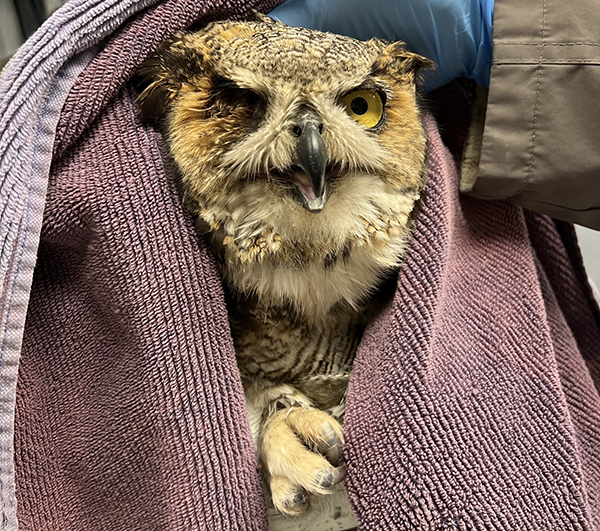
Great Horned Owl patient
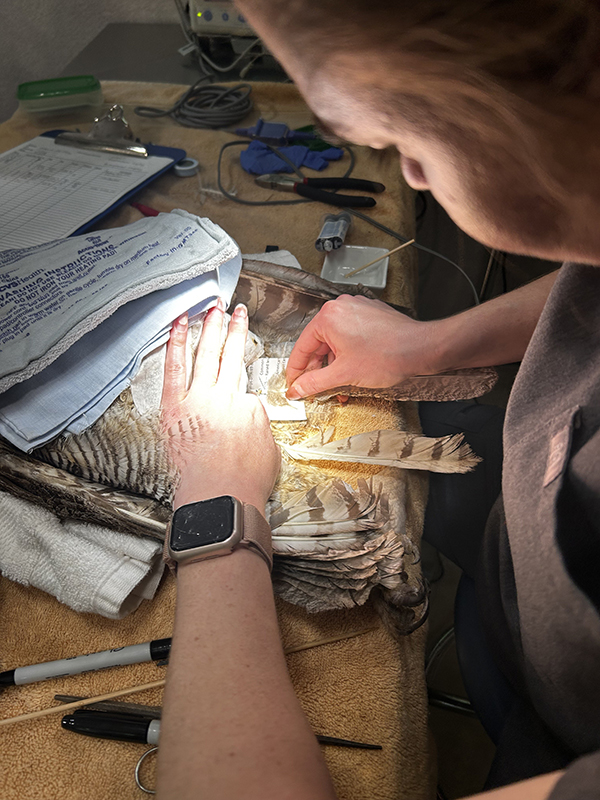
Dr. Lauren performs the imping operation
In addition to their foot wound, this patient had a corneal ulcer in their right eye. Like their foot, this injury was slow to heal. After a couple of weeks with little improvement, we consulted our local veterinary ophthalmologist for a closer look. Together, we pursued advanced treatments to promote healing.
Though we were hopeful, the eye was still not healing as we would have liked. When it became clear that their eye was not recovering, and could compromise their overall health, we chose a different path.
A delicate surgery, called ocular evisceration, was performed by CWC’s team to remove the damaged contents of the eye while preserving its outer boney structure. In owls, this technique is superior and less invasive than full eye removal, as it preserves facial symmetry and essential structures to support hearing. Both are important for survival in the wild.
The patient’s recovery from surgery was smooth, but another critical question remained: could they still hunt with one functioning eye?
Nocturnal predator patients like this Great Horned Owl need to pass a live prey test to demonstrate their ability to locate and capture food. It was no surprise that with their resilience, they passed the test.
But this owl’s journey wasn’t over yet.
Time in care had taken a toll on their flight feathers, which are essential not just for flight, but for the near-silent movement owls rely on to hunt. Damaged feathers can mean the difference between survival and starvation in the wild.
Using a centuries-old technique called feather imping, we performed one final procedure. Feather imping involves carefully replacing broken feathers with donor ones, restoring a bird’s ability to fly effectively and quietly without waiting for an animal to molt, which can take many months.
Finally, the day came for their last test: flight evaluation. They needed to demonstrate strength, control, and silence in the air. As they lifted off and crossed the flight space with smooth, soundless precision, it was clear they were ready.
This great horned owl’s path through rehabilitation was anything but simple. It required advanced medical care, specialized expertise, and weeks of dedicated support from our staff and volunteers. But it also required something we cannot provide- the animal’s own determination to survive.