
• Link to Facebook
  • Link to X
  • Link to Youtube
  • Link to Instagram
  • Link to Mail
MEDICAL EMERGENCY? CALL: +1 310 458-WILD(9453)
DONATE
California Wildlife Center
  • Home
  • About Us
    • What We Do
    • Our Team
    • Education
  • Animal Resources
    • Medical Emergency
    • Co-Existing with Wildlife
    • FAQ
    • Animal Profiles
    • Gallery
  • Support Us
    • Ways to Support Us
      • Donate & Support Wildlife
      • Conservation Circle
      • Sponsor an Animal
      • Our Wish List
      • Other Ways to Give
  • Get Involved
    • Employment
    • Volunteer
      • Become a Volunteer
      • Internships
      • Externships
  • Events
  • News & Blog
    • In the News
    • Newsletters
    • Patient of the Week
    • Edison
    • From the Community
    • Videos
    • Gallery
    • Media Requests
  • Contact
  • Store
  • Click to open the search input field Click to open the search input field Search
  • Menu Menu

To Raise a Mockingbird

By Cori Carlson, Administrative Coordinator
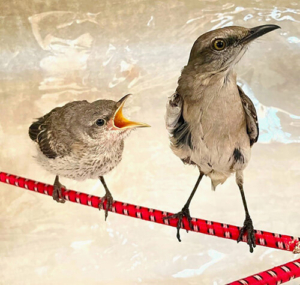
Adult female Northern Mockingbird perches next to nestling Northern Mockingbird.

You have surely heard, if not seen, a Northern Mockingbird in your area. They can be heard serenading at any time of the day and night and can mimic hundreds of noises. This small gray bird with white patches on their wings and long tail feathers, can be found in grasslands, wooded areas, or in your backyard.

In mid-March an orphaned nestling (a baby bird who should still be in the nest being cared for by their mother) was found in West Los Angeles, and was admitted mildly dehydrated, but otherwise healthy.

Typically, we group young animals of the same species and rear them together. Baby birds are most successful when they are raised with others of the same species, learning from each other. However, this young bird came in alone and it was weeks until we received a second Mockingbird. Fortunately, nature had other plans for this special patient.

An adult female Northern Mockingbird was admitted having lost most of her tail feathers after being stuck to a glue trap. While her feathers grew back, our team moved her into the enclosure with the fledgling. Their hope was that she would teach the younger bird species-specific behaviors including how to forage and feed. This blending has been a resounding success.

After a little more than a month in care, the young Northern Mockingbird is now ready to move into an outdoor aviary to acclimate to the temperatures and strengthen their flight muscles before being released into the wild to make beautiful music.

LATEST POSTS

  • The Education Corner: RenestingMay 13, 2026 - 11:40 am
  • Rescuing Stranded Marine Mammals during an Outbreak of Avian InfluenzaMay 13, 2026 - 11:38 am
  • Wild BeginningsMay 13, 2026 - 11:33 am
  • Through Darkness back to FlightMay 13, 2026 - 11:30 am

Contact Us

P.O. Box 2022
Malibu, CA 90265
E-mail: admin@cawildlife.org

Contact Us

P.O. Box 2022
Malibu, CA 90265
Hotline Phone: +1 310 458-WILD (9453)
E-mail: admin@cawildlife.org

DONATE TO CWC
CWC Tax ID#95-4580790

SIGN UP FOR OUR NEWSLETTER

CLICK HERE TO SIGN UP

Quick Links

Privacy Policy
Financials & Legal Info

Join us on Facebook!

Categories

BLOG ARCHIVES

© California Wildlife Center | All Rights Reserved | Webmaster SV3 Designs
  • Link to Facebook
  • Link to X
  • Link to Youtube
  • Link to Instagram
  • Link to Mail
Link to: Incredible Interns and Volunteers Link to: Incredible Interns and Volunteers Incredible Interns and Volunteers Link to: Western Coachwhip Link to: Western Coachwhip Western Coachwhip
Scroll to top Scroll to top Scroll to top

JOIN TODAY


Yes! Keep me updated about the animals at CWC

Enter your email address for the chance to win a private tour of CWC


    Your information will never be shared with a third party