• Link to Facebook
  • Link to X
  • Link to Youtube
  • Link to Instagram
  • Link to Mail
MEDICAL EMERGENCY? CALL: +1 310 458-WILD(9453)
DONATE
California Wildlife Center
  • Home
  • About Us
    • What We Do
    • Our Team
    • Education
  • Animal Resources
    • Medical Emergency
    • Co-Existing with Wildlife
    • FAQ
    • Animal Profiles
    • Gallery
  • Support Us
    • Ways to Support Us
      • Donate & Support Wildlife
      • Conservation Circle
      • Sponsor an Animal
      • Our Wish List
      • Other Ways to Give
  • Get Involved
    • Employment
    • Volunteer
      • Become a Volunteer
      • Internships
      • Externships
  • Events
  • News & Blog
    • In the News
    • Newsletters
    • Patient of the Week
    • Edison
    • From the Community
    • Videos
    • Gallery
    • Media Requests
  • Contact
  • Store
  • Click to open the search input field Click to open the search input field Search
  • Menu Menu

Mockingbirds: Masters of Mimicry, with just a Note of Mystery!

March 6, 2019/in Birds

By Melissa Hartman

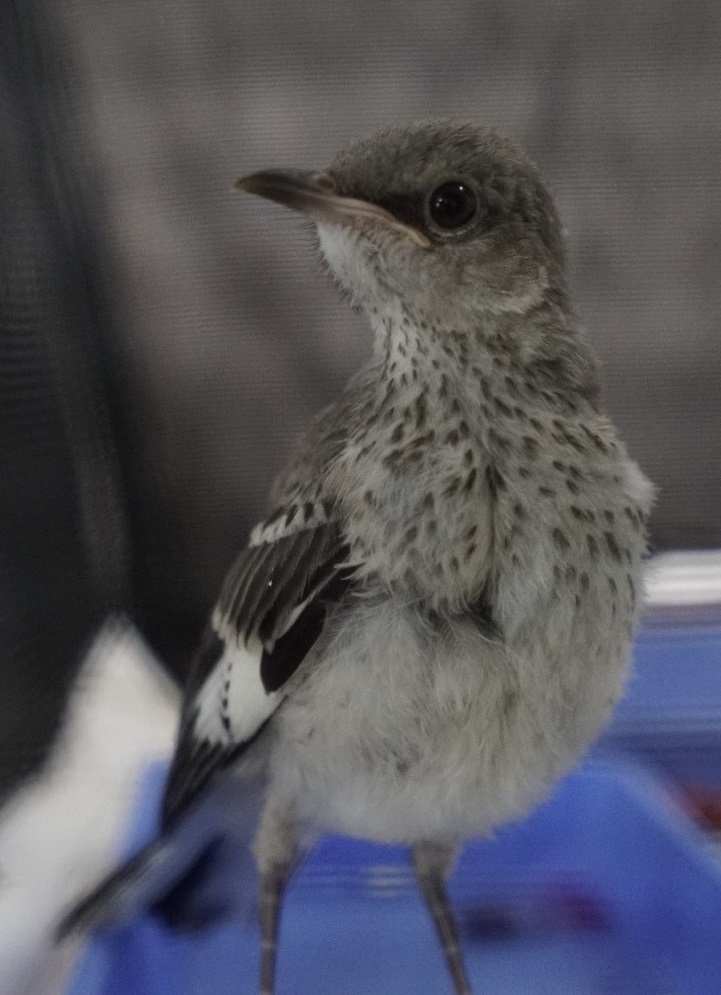
CWC sees many fledgling mockingbirds each year Photo by Jamie Pelayo


Mockingbirds sing one heckuva lot. You can hear them all year long, at

any time of the day, compiling sequences of repeated phrases, including riffs on calls made by other bird species. Like other songbirds, Mockingbirds’ songs are used mainly for courting or to defend territory.

Weighing in at a measly two ounces, a male Northern Mockingbird can produce several hundred phrases, picking up notes acoustically comparable to their own cadence and tone, including calls of other birds such as Jays, Hawks, Orioles, Robins and many others, as well as non-avian impersonations of dogs, cats, frogs—and even car alarms, cell phones and police sirens! They’re not called by their scientific name, Mimus polyglottos—”mimic of many tongues”—for nuthin’.

The Northern Mockingbird is one of 14+ Mockingbird species, many of which “mock,” but why? Some bird species imitate others to frighten their neighbors and steal their food; however, scientists have noted no change in behavior in birds imitated by Mockingbirds. Birds also are known to copy songs as a courtship strategy, but leading bird behaviorists cannot conclusively point to this as a hypothesis for why exactly Mockingbirds mock.

Last year at California Wildlife Center, Northern Mockingbirds were ninth of the ten most frequent species of the 4,300 animal patients seen. We took in 122 for a number of reasons: caught by cats, attacked by raccoons, with broken limbs, injured in window-strikes, orphaned.

As a CWC patient, the Northern Mockingbird is talkative and curious. It’s a pleasure to care for and release them to continue their amazing vocalizing in the wild!


Share this entry
  • Share on Facebook
  • Share on X
  • Share on WhatsApp
  • Share on LinkedIn
  • Share on Reddit
  • Share by Mail
https://cawildlife.org/wp-content/uploads/2026/05/CWClogo.png 0 0 protectanimals https://cawildlife.org/wp-content/uploads/2026/05/CWClogo.png protectanimals2019-03-06 16:57:152019-03-06 16:59:44Mockingbirds: Masters of Mimicry, with just a Note of Mystery!

LATEST POSTS

  • The Education Corner: RenestingMay 13, 2026 - 11:40 am
  • Rescuing Stranded Marine Mammals during an Outbreak of Avian InfluenzaMay 13, 2026 - 11:38 am
  • Wild BeginningsMay 13, 2026 - 11:33 am
  • Through Darkness back to FlightMay 13, 2026 - 11:30 am

Contact Us

P.O. Box 2022
Malibu, CA 90265
E-mail: admin@cawildlife.org

Contact Us

P.O. Box 2022
Malibu, CA 90265
Hotline Phone: +1 310 458-WILD (9453)
E-mail: admin@cawildlife.org

DONATE TO CWC
CWC Tax ID#95-4580790

SIGN UP FOR OUR NEWSLETTER

CLICK HERE TO SIGN UP

Quick Links

Privacy Policy
Financials & Legal Info

Join us on Facebook!

Categories

BLOG ARCHIVES

© California Wildlife Center | All Rights Reserved | Webmaster SV3 Designs
  • Link to Facebook
  • Link to X
  • Link to Youtube
  • Link to Instagram
  • Link to Mail
Link to: California Wildlife Center responds to beached pygmy sperm whale Link to: California Wildlife Center responds to beached pygmy sperm whale California Wildlife Center responds to beached pygmy sperm whale Link to: Marine Mammal Department Braces for an Unpredictable Season Link to: Marine Mammal Department Braces for an Unpredictable Season Marine Mammal Department Braces for an Unpredictable Season
Scroll to top Scroll to top Scroll to top

JOIN TODAY


Yes! Keep me updated about the animals at CWC

Enter your email address for the chance to win a private tour of CWC


    Your information will never be shared with a third party