
The Unfortunate Side Effects of Glue Traps
By Alex Willis, Wildlife Technician
Glue traps are devices designed to kill rodents and other pests. They come in a variety of sizes and consist of a flat surface covered in non-drying, non-toxic glue. They are marketed as an effective and clean option for removing pests from your home. However, they are inhumane devices that indiscriminately trap whatever animal is unfortunate enough to cross them. The glue does not kill the animal, instead it holds them in place, rendering them unable to escape. The animal slowly dies of starvation, dehydration, stress, or suffocation. This process can take days. The animal will try anything they can to escape the glue traps- ripping out feathers and fur, fracturing, and even biting through their own limbs to escape. Their panicked attempts to flee often further entrap them in the glue. At CWC we receive all kinds of wildlife stuck in glue traps. Some patients we can safely remove and rehabilitate, while others have injured themselves to the point that they cannot be saved.
One such patient we received was a Great Horned Owl. This owl was left at the North Central Animal Shelter in Los Angeles and was transported to CWC by one of our dedicated volunteers. The patient arrived with extensive glue contamination over much of their body. Both wings had large amounts of glue on them which stuck all the feathers together and then stuck those feathers to their body. Both legs had thick wads of glue on the lower halves that were also stuck to the tail feathers. While too large to be held down by the weight of the trap, the extensive contamination of the wings and tail meant the bird could no longer fly. An owl who cannot fly cannot find food, shelter, or escape predators. Even though the traps had been removed, this amount of glue contamination meant that the animal would not survive in the wild. The shelter had very little information about this patient, but what we suspect occurred was that the owl saw a rodent or other small animal struggling on a glue trap and swooped down for what they thought was an easy meal. Instead, they got covered in glue. Even large predators can be victims of these traps.
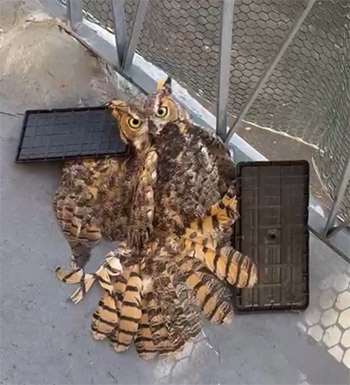
Picture of the patient stuck in the glue trap
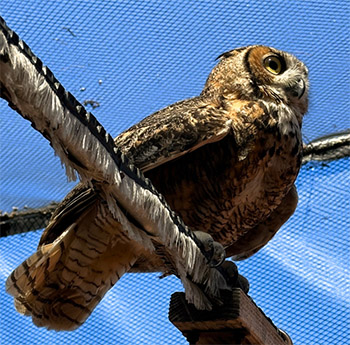
Patient perching in enclosure
We were able to remove some of the glue contamination so that the patient’s wings were no longer stuck to their body and their tail feathers were no longer stuck to their legs. We then covered the glued areas in a ground cornmeal diet to remove any remaining stickiness that might cause the bird to stick to themself or the enclosure. This patient was then sent to International Bird Rescue in San Pedro where they have state of the art facilities for washing oil off contaminated sea birds. These facilities also work well for washing glue off animals. The owl returned to CWC glue free and very fractious. After several weeks of wound treatment and rehabilitation at CWC, the patient was released by one of our longtime donors.
Glue traps kill animals slowly and painfully and often do not even kill the animals they were intended for. Please do not use glue traps in or around your home. In 2023 West Hollywood became the first American city to ban the use and sale of glue traps, and in 2024 Ojai joined them. We are hopeful that there will be a day in the near future when glue traps are banned in every city!