
The Story of Orange
By Alexis Sierra, RVTg, Stranding Coordinator
Each year, during the months of March-May, our Marine Mammal Rescue team at CWC receives a high volume of calls regarding stranded Northern Elephant Seal pups on the beaches in Malibu. Northern Elephant Seal pups are born in late December through early February and have an abrupt weaning period of just over four weeks. They will then make their journey into the ocean for the first time, primarily relying on instinct. Seal pups may begin to have difficulty in the ocean for a variety of reasons, including starvation, trauma, parasites, or human interaction, and may begin to haul out and end up in rehabilitative care. Each pup that comes in for rehabilitation receives a second chance at life, which was the case for patient #25-097.
On March 12, our team responded to a report of a stranded Northern Elephant Seal pup on El Sol Beach in Malibu. This patient was nicknamed “Orange,” for the non-toxic grease marker applied as identification. During her intake examination, staff observed that this patient was severely emaciated, dehydrated, and had a cloudy right eye that appeared to have a sunken appearance. After weaning from their mothers, pups typically weigh around 300lbs. Meaning that Orange, who only weighed 59lbs, had lost a significant amount of weight, falling just below birth weight (60-80lbs). Elephant seal pups that come into care at her weight range are considered extremely critical patients, as they do not have the proper layer of blubber to maintain their nutrition, insulation, or buoyancy to survive in the wild. Orange was promptly started on nutritional supplements to assist in weight gain, subcutaneous fluids to aid in hydrational therapy, as well as pain medication and antibiotics to combat any infection that may have been caused by her damaged eye.
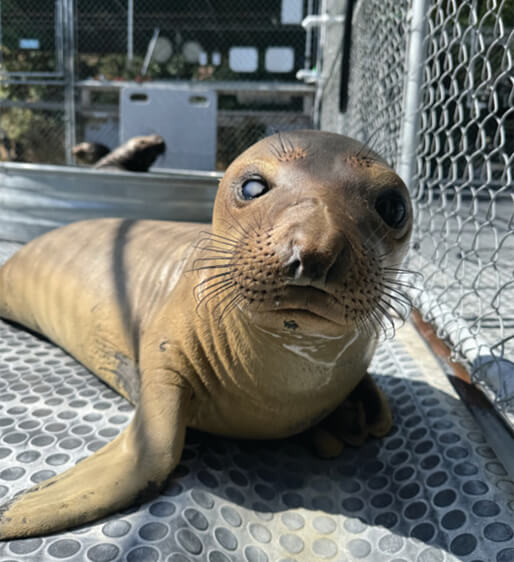
Orange in care at CWC
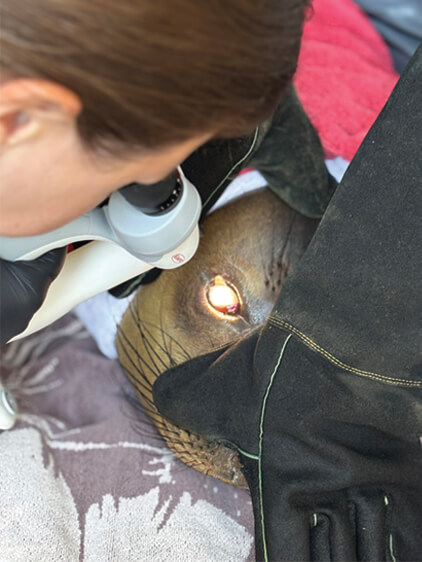
Dr. Goldenberg and team examine Orange’s eye.
While in care, the rehab team observed that Orange quickly learned to self-feed, although her subsequent progress was slow. She appeared to have difficulty swallowing and often left large amounts of fish in the pool. Once she was moved into our larger pool and learned how to compete with other seals, she happily adapted, overcame her challenges, and met important milestones to prepare her for life in the wild.
Northern Elephant Seal pups are still considered releasable with one visual eye. Due to their deep diving nature, Elephant Seals primarily rely on other senses, such as their vibrissae (whiskers), to aid in foraging for food. The non-visual eye did not cause discomfort and remained stagnant while in care. Our Director of Animal Care, Dr. Lauren Michaels, brought in Dr. Goldenberg and her dedicated staff at Veterinary Eye Clinic to examine Orange’s eye utilizing specialized equipment. With the support of the veterinary specialists and rehabilitation team, Orange was cleared for release in early August, breaking the record for longest patient we’ve had in care.
On August 6th, after 147 days and gaining about two and a half times her intake weight, Orange was released off a boat near Santa Rosa Island through our partnership with Island Packers. Special thank you to our staff, volunteers, and partners for making this moment possible. It all starts with you – report concerns on the beaches in Malibu to our Marine Mammal Rescue Team at 310-924-7256.
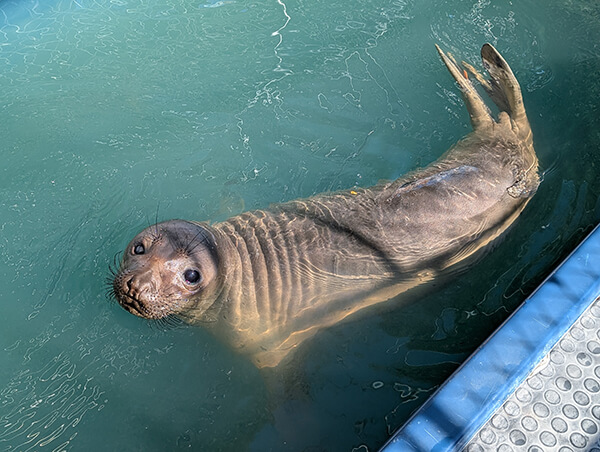
Orange spends time in pool