
When Birds Collide with Windows
By Denys Hemen, Hospital Manager
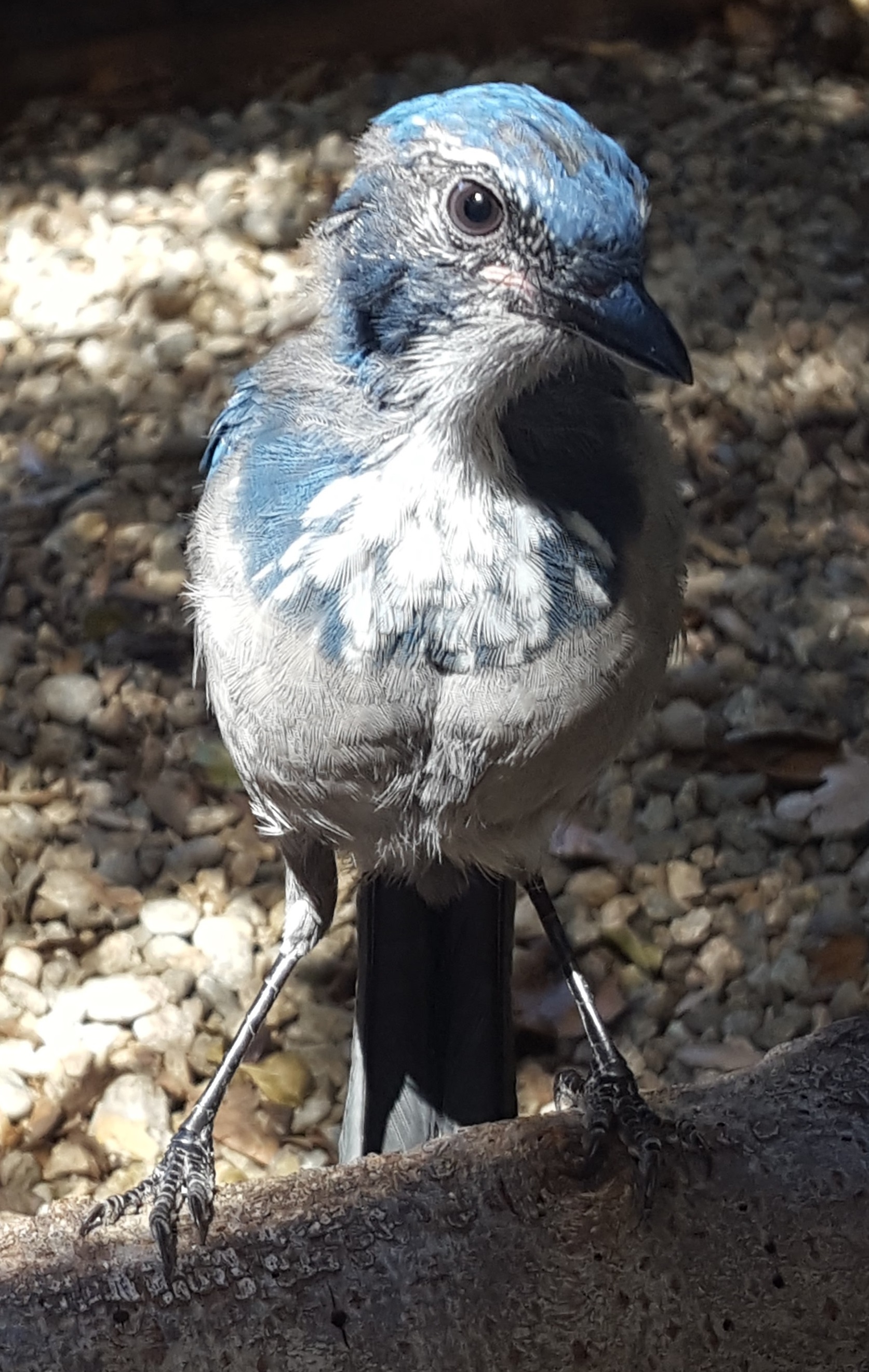
Western Scrub Jays are often victims of window strikes
Photo by Alyssa Schlange
It’s a sight–and sound– sure to startle anyone who is a witness; you look up to see a bird hit your window, and immediately run outside to check on the welfare of the unfortunate creature. An estimated billion birds die from window stricks annually in the U.S. alone. Along with attacks by outdoor cats, window strikes are among the leading causes of the steep population decline seen in almost every species of songbird.
Birds collide with windows because they do not see them as solid structures and try to fly through them. Even small windows can be a problem because birds often look for narrow escape routes when being chased by predators. A bird may also fly into glass because a building’s surrounding vegetation is reflected onto the surface of the windows, or there is vegetation inside that the bird can see and attempts to fly into it. Glass walls installed around properties and on balconies are especially troublesome for birds.
California Wildlife Center receives dozens of birds each year with eye, head, and shoulder trauma from window collisions. Although the cause for much of this trauma is unknown, there were 65 patients last year brought to CWC because a rescuer had seen or heard the window strike. Not all birds are fortunate enough to recover from window strikes. Most are taken by predators while in a stunned state, and others may stumble off and perish while hidden from view.
If you have windows that birds are drawn to, there are a few options to prevent collisions. By far the easiest remedy available is bird tape. This reflective tape gives the window an appearance that resembles a solid structure. Other options available are “bird-proof” glass and adhesive films that can be applied to give the window the appearance of impermeability. Please remember always to keep bird feeders away from your windows.
If you witness a bird striking a window, there are a few things you can do to help. Quickly find a box suitable for the bird’s size that can be closed. Place something soft in the bottom, such as an old t-shirt or a towel, and puncture the box several times to provide adequate ventilation. Gently pick up the bird using your hands and quickly place the bird in the box, closing it immediately. If it is a larger bird, you may cover it with a towel when you pick it up to aid in its capture and to protect you from a bite. For birds of prey, such as hawks or owls, never attempt to pick them up with bare hands. Turn your box sideways and try to push the bird into the box using a broom or similar tool. For larger birds or birds of prey, keep the bird somewhere dark and quiet and call CWC at (310) 458-WILD. If it is a small songbird that struck your window, you can bring the bird inside to a quiet room for two hours. After that time, go outside and open the box. Sometimes the bird is only stunned and needs a little time to recuperate in a safe place. In this case, the lucky bird will fly out of the box and your work is done! If the bird is unable to fly or stand after this time, please contact CWC immediately.
Limiting a feeder’s exposure will reduce a predator’s ability to startle visiting songbirds into nearby windows.
“Amazing” describes a hawks ability to design and execute the attack vector on unsuspecting prey. The entire process takes 3-5 seconds to startle, assess damage, then drop onto a stunned victim. Red Shouldered and Coopers are particularly adept at doing this.