• Link to Facebook
  • Link to X
  • Link to Youtube
  • Link to Instagram
  • Link to Mail
MEDICAL EMERGENCY? CALL: +1 310 458-WILD(9453)
DONATE
California Wildlife Center
  • Home
  • About Us
    • What We Do
    • Our Team
    • Education
  • Animal Resources
    • Medical Emergency
    • Co-Existing with Wildlife
    • FAQ
    • Animal Profiles
    • Gallery
  • Support Us
    • Ways to Support Us
      • Donate & Support Wildlife
      • Conservation Circle
      • Sponsor an Animal
      • Our Wish List
      • Other Ways to Give
  • Get Involved
    • Employment
    • Volunteer
      • Become a Volunteer
      • Internships
      • Externships
  • Events
  • News & Blog
    • In the News
    • Newsletters
    • Patient of the Week
    • Edison
    • From the Community
    • Videos
    • Gallery
    • Media Requests
  • Contact
  • Store
  • Click to open the search input field Click to open the search input field Search
  • Menu Menu

Room for Swallows to Soar

February 21, 2017/in Birds

By Denys Hemen, Hospital Manager

Cliff Swallow

A Cliff Swallow eats a mealworm “on the wing.”
Photo By Jenn Guess

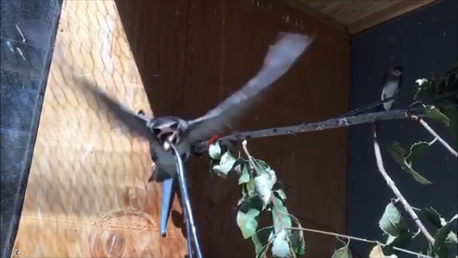
Here at California Wildlife Center space has always been at a premium. As the only rehab center in Los Angeles County that rehabilitates baby songbirds, space disappears quickly in the springtime. But, anytime you get a large number of baby birds crammed into a small area many problems can arise. It becomes very hard to keep them clean. Internal parasites can run rampant. In general, just being inside can cause some developmental issues. Birds just want to be outside where they belong! Our swallows were getting anxious to stretch their wings but would continue to eat from our hands inside. They are notorious for their extended weaning period. These trouble makers would constantly escape from their enclosure and fly around the room but were still too young for our large aviary. That’s why we have constructed our fledgling cliff swallow aviary!

This small ( 6ft x6ftx 8ft tall ) but secure aviary allows our younger swallows, who aren’t quite ready for the big aviary yet, to stretch their wings. They have more room to move around and develop at a much quicker pace. Inside their aviary, we have free choice food but some of these young ones haven’t quite grasped the whole self-feeding thing yet. That is where we come in! Every 45 mins we enter the aviary and hold up a juicy worm with tweezers. The swallows swarm around, dive down, and grab the worm from our grasp! This gives them some much needed practice because once in the wild these birds will catch flying insects “on the wing”. We also collect fruit scraps in buckets that are left inside the aviary to attract fruit flies. The swallows practice their hunting skills on these tiny flying insects.

Once the whole group is eating on their own and refuse hand-feeding, we move them to an aviary that is nearly 10 times larger where they develop their flight muscles and prepare to move on to the next step, a release into the wild!
https://cawildlife.org/wp-content/uploads/2026/05/CWClogo.png 0 0 protectanimals https://cawildlife.org/wp-content/uploads/2026/05/CWClogo.png protectanimals2017-02-21 22:37:482017-02-21 23:48:27Room for Swallows to Soar

Bumper Crop for Baby Care Unit

October 31, 2016/in Birds

By Hospital Manager Denys Hemen

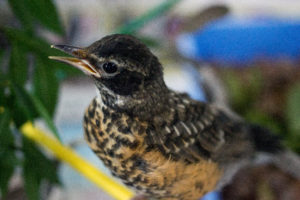
Orphaned birds like this young American robin are placed in CWC's Baby Care Unit while they receive the treatment and diet necessary for them to grow. Photo by Kim Barker

Orphaned birds like this young American robin are placed in CWC’s Baby Care Unit while they receive the treatment and diet necessary for them to grow. Photo by Kim Barker

It was another great year inside of our baby bird nursery at California Wildlife Center.  We are the only wildlife rehabilitation center in Los Angeles County that takes in baby songbirds, baby crows, and baby ravens. Due to this fact, we have to dedicate lots of space to their care.  We added 128 square feet of indoor space to our existing 14 enclosures that are dedicated to baby songbirds, crows, and ravens.  It took our team a lot of blood, sweat, and tears to accomplish but it was well worth it.

We were able to release hundreds of birds back to the wild. There was a wide array of birds that traveled through our doors this summer. There are the most common species we care for and raised: northern mockingbirds, black phoebes, house wrens, western scrub jays, western kingbirds, cliff swallows, mourning doves, dark-eyed juncos, American robins, house finches, bushtits, acorn woodpeckers, California towhees, American crows, lesser goldfinches, and common ravens.

At the height of the season, we were ordering 60,000 mealworms, 1000 waxworms, and 2000 crickets per week to feed the songbirds and 50 pounds of dog food, protein, eggs, and produce per week for the crows and ravens!  Our dedicated team of staff, interns, and volunteers worked 13-hour days to feed all of the open and hungry mouths.

Baby bird season has just ended at CWC.  We put our last group of northern mockingbird babies out in the aviaries last week.  It was a tough summer! But before we even take a breath, 48 baby squirrels moved into the nursery!

https://cawildlife.org/wp-content/uploads/2026/05/CWClogo.png 0 0 protectanimals https://cawildlife.org/wp-content/uploads/2026/05/CWClogo.png protectanimals2016-10-31 23:10:002016-10-31 23:11:07Bumper Crop for Baby Care Unit

Snowshoes in the Summer

August 19, 2016/9 Comments/in Birds, Wildlife Medicine

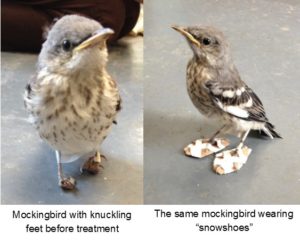
California Wildlife Center recently rescued a Northern Mockingbird whose feet were knuckling, meaning she was unable to open her feet to stand or perch.  This was causingbefore and after snowshoes the bird to have to stand on the tops of her toes which were curled under and causing her additional injury.
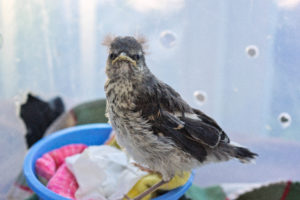
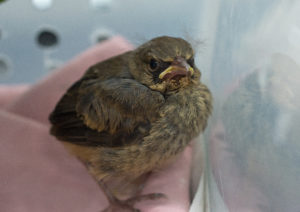
CWC veterinary staff created “snowshoes” for the mockingbird to retrain her feet to open and allow the injuries to her toes to heal.  The treatment was successful and the bird is now snowshoe-free and on the road to full recovery!

https://cawildlife.org/wp-content/uploads/2026/05/CWClogo.png 0 0 protectanimals https://cawildlife.org/wp-content/uploads/2026/05/CWClogo.png protectanimals2016-08-19 16:54:132016-08-19 16:54:22Snowshoes in the Summer

New Aviary Filled with Unkindnesses and Murders

July 5, 2016/in Birds
Ravens by Heather Patrice Brown

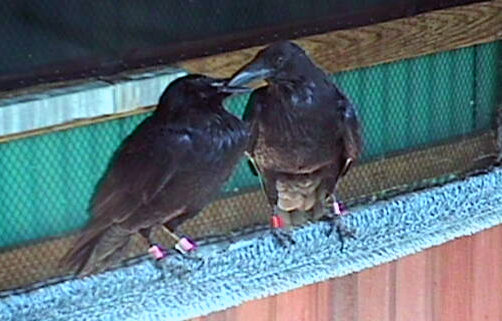
Ravens and crows enjoy the new enclosure. Photo by Heather Patrice Brown

By Development Coordinator, Heather Patrice Brown

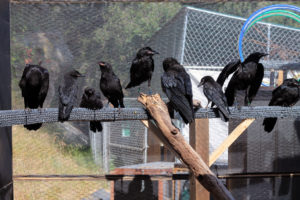
“Squawk!” “Caw-caw!” The new exterior aviary, sponsored by the Wendy McCaw Foundation, is anything but a quiet, peaceful place.  This 8’ x 16’ enclosure currently houses both a murder of American crows and an unkindness of common ravens that arrived as orphaned babies.  The aviary provides multiple perches in both sun and shade. This aviary provides a little room for the rowdy birds to stretch their wings and perch in the sun or the shade while being hand fed. Once they eat on their own, they graduate to the large 25′ x 25′ x 12′ aviary!

Ravens and crows belong to a family of birds called Corvidae.  Members of the family, which also include jays and magpies, are referred to as a group as Corvids, and are often considered some of the smartest birds in the world.  California Wildlife Center staff and volunteers often give the ravens and crows toys or hide their food in puzzles as enrichment and to teach them valuable skills they will need in the wild.

https://cawildlife.org/wp-content/uploads/2026/05/CWClogo.png 0 0 protectanimals https://cawildlife.org/wp-content/uploads/2026/05/CWClogo.png protectanimals2016-07-05 21:51:022016-07-05 21:53:19New Aviary Filled with Unkindnesses and Murders

What Are You Looking At?

July 5, 2016/in Birds

The many different faces of wildlife rehabilitation

Northern Mockingbird by Denys Hemen

A Northern mockingbird gives a glare to CWC rehabilitators. Photo by Denys Hemen

By Hospital Manager, Denys Hemen

Spring came with a bang this year as our nursery exploded with baby birds. California Wildlife Center is the only wildlife rehabilitation center in Los Angeles County that takes in native baby songbirds. We get in hundreds of individuals of many different species….all of which look grumpy. No matter what we do we cannot erase the look of disgust from these birds faces. We hand feed mealworms, waxworms, and crickets for 12 hours a day. Everyone gets a special vitamin supplement daily to help them grow stronger. We add natural leafy branches to the insides of their enclosures. We weigh them all every other day to make sure each bird is properly gaining weight. Still all we get are grumpy faces! It doesn’t bother us though. We just shrug it off because in the end we are all here for one thing…. to see the angry looking little birds grow into beautiful happy juveniles and take off into the sky to be free again.

California Towhee by Denys Hemen

A California towhee (above) awaits its next feeding. Photo by Denys Hemen


https://cawildlife.org/wp-content/uploads/2026/05/CWClogo.png 0 0 protectanimals https://cawildlife.org/wp-content/uploads/2026/05/CWClogo.png protectanimals2016-07-05 17:44:282016-07-05 19:49:57What Are You Looking At?

Feeding Baby Birds

June 20, 2016/in Birds, Uncategorized

Click on the photo to see how baby birds at California Wildlife Center are fed.

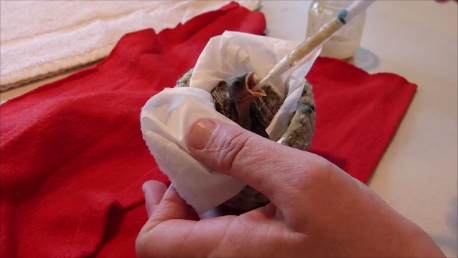
Young songbirds need to be fed frequently with a syringe filled with a special baby bird formula.

Young songbirds need to be fed frequently with a syringe filled with a special baby bird formula.

https://cawildlife.org/wp-content/uploads/2026/05/CWClogo.png 0 0 protectanimals https://cawildlife.org/wp-content/uploads/2026/05/CWClogo.png protectanimals2016-06-20 19:43:362016-06-20 19:43:36Feeding Baby Birds

How “Creancing” Helped a Falcon Fly

May 4, 2016/in Birds, CWC, Wildlife Medicine
Read more
https://cawildlife.org/wp-content/uploads/2016/05/FullSizeRender7.jpg 1379 815 protectanimals https://cawildlife.org/wp-content/uploads/2026/05/CWClogo.png protectanimals2016-05-04 01:56:202016-06-08 16:23:15How “Creancing” Helped a Falcon Fly

Helping Birds Get Their “Wings” Back

May 1, 2016/in Birds, CWC, Wildlife Medicine
Read more
https://cawildlife.org/wp-content/uploads/2016/05/20151021_155933.jpg 2448 3264 protectanimals https://cawildlife.org/wp-content/uploads/2026/05/CWClogo.png protectanimals2016-05-01 01:20:582016-06-08 16:22:59Helping Birds Get Their “Wings” Back

Star-Crossed Ravens

April 28, 2016/in Birds, CWC, Wildlife Medicine
Read more
https://cawildlife.org/wp-content/uploads/2016/05/Star-Raven.jpg 335 502 protectanimals https://cawildlife.org/wp-content/uploads/2026/05/CWClogo.png protectanimals2016-04-28 02:03:192016-06-08 16:22:52Star-Crossed Ravens

Winter is Coming!

December 28, 2015/in Birds, CWC, Wildlife Medicine
Read more
https://cawildlife.org/wp-content/uploads/2016/05/image2.jpg 3264 2448 protectanimals https://cawildlife.org/wp-content/uploads/2026/05/CWClogo.png protectanimals2015-12-28 02:05:562016-06-08 16:22:42Winter is Coming!
Page 7 of 8«‹5678›

LATEST POSTS

  • The Education Corner: RenestingMay 13, 2026 - 11:40 am
  • Rescuing Stranded Marine Mammals during an Outbreak of Avian InfluenzaMay 13, 2026 - 11:38 am
  • Wild BeginningsMay 13, 2026 - 11:33 am
  • Through Darkness back to FlightMay 13, 2026 - 11:30 am

Contact Us

P.O. Box 2022
Malibu, CA 90265
E-mail: admin@cawildlife.org

Contact Us

P.O. Box 2022
Malibu, CA 90265
Hotline Phone: +1 310 458-WILD (9453)
E-mail: admin@cawildlife.org

DONATE TO CWC
CWC Tax ID#95-4580790

SIGN UP FOR OUR NEWSLETTER

CLICK HERE TO SIGN UP

Quick Links

Privacy Policy
Financials & Legal Info

Join us on Facebook!

Categories

BLOG ARCHIVES

© California Wildlife Center | All Rights Reserved | Webmaster SV3 Designs
  • Link to Facebook
  • Link to X
  • Link to Youtube
  • Link to Instagram
  • Link to Mail
Scroll to top Scroll to top Scroll to top

JOIN TODAY


Yes! Keep me updated about the animals at CWC

Enter your email address for the chance to win a private tour of CWC


    Your information will never be shared with a third party