• Link to Facebook
  • Link to X
  • Link to Youtube
  • Link to Instagram
  • Link to Mail
MEDICAL EMERGENCY? CALL: +1 310 458-WILD(9453)
DONATE
California Wildlife Center
  • Home
  • About Us
    • What We Do
    • Our Team
    • Education
  • Animal Resources
    • Medical Emergency
    • Co-Existing with Wildlife
    • FAQ
    • Animal Profiles
    • Gallery
  • Support Us
    • Ways to Support Us
      • Donate & Support Wildlife
      • Conservation Circle
      • Sponsor an Animal
      • Our Wish List
      • Other Ways to Give
  • Get Involved
    • Employment
    • Volunteer
      • Become a Volunteer
      • Internships
      • Externships
  • Events
  • News & Blog
    • In the News
    • Newsletters
    • Patient of the Week
    • Edison
    • From the Community
    • Videos
    • Gallery
    • Media Requests
  • Contact
  • Store
  • Click to open the search input field Click to open the search input field Search
  • Menu Menu

Oh Deer! CWC Helps a Deer Impacted by Plastic Waste

December 14, 2018/2 Comments/in Terrestrial Animals, Uncategorized, Wildlife Medicine

By Dr. Stephany Lewis, Veterinarian

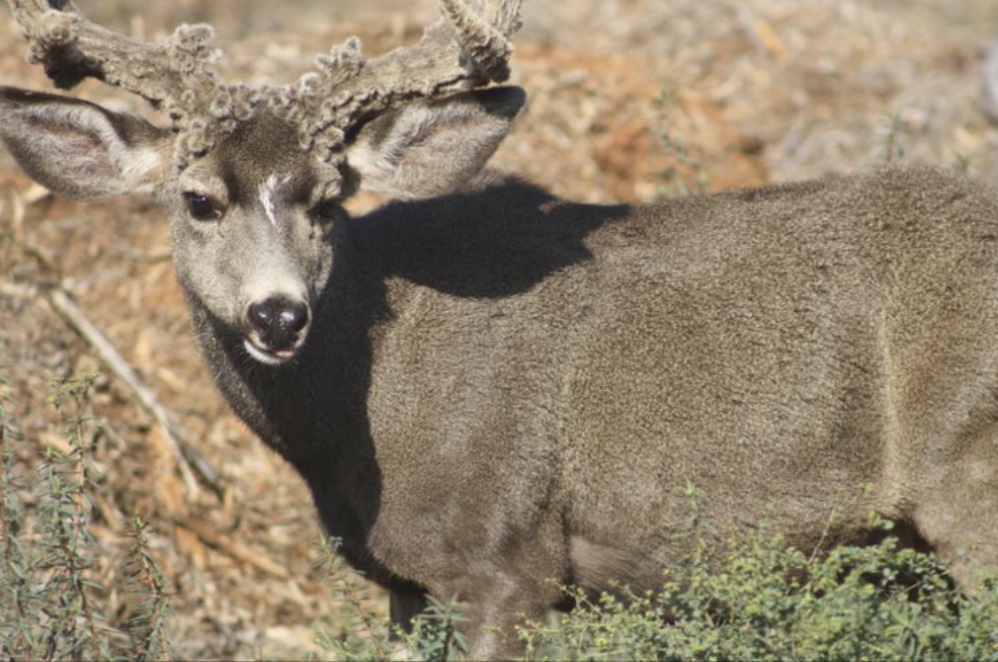
This Mule Deer buck had a plastic pipe stuck on his leg. Photo by Heather Henderson

This fall the California Wildlife Center was given a unique opportunity to help a Mule Deer buck who had gotten PVC piping entrapped on one of his legs. A caring citizen named Brenda Robinson contacted our hospital manager, Denys Hemen, regarding this buck in need of help. The buck spent much of his time with a herd at the Getty Villa, and a few days prior Brenda had noticed that the animal had gotten a piece of white PVC piping trapped just above his hoof. He was licking at the area and had begun to limp on the leg.  Brenda was worried that this animal was in pain and would eventually be weakened to the point that he could fall prey to coyotes or mountain lions known to be in the area.

After learning of the situation, Denys and I visited with Brenda at the Getty Villa to observe the Deer and see if it would be feasible for us to help the animal. Brenda knew exactly where the herd would be throughout the morning, and he was so accustomed to her presence that we were able to observe him from a reasonable distance. We were excited to be able to potentially help this animal, and after organizing with biologist Amelia Viera at the California Fish and Wildlife Service, we were scheduled to return on the morning of October 30th to sedate the Deer and remove the plastic pipe from his leg.

The morning of October 30th, the group of us involved in the procedure as well as grounds crew at the Getty Villa, met just before sunrise to discuss the plan of action. Immobilizing an adult Deer in the field requires quite a bit of preparation, and it’s extremely important that everyone involved knows each step in the procedure, what to expect, what could go wrong, and what their responsibilities are.
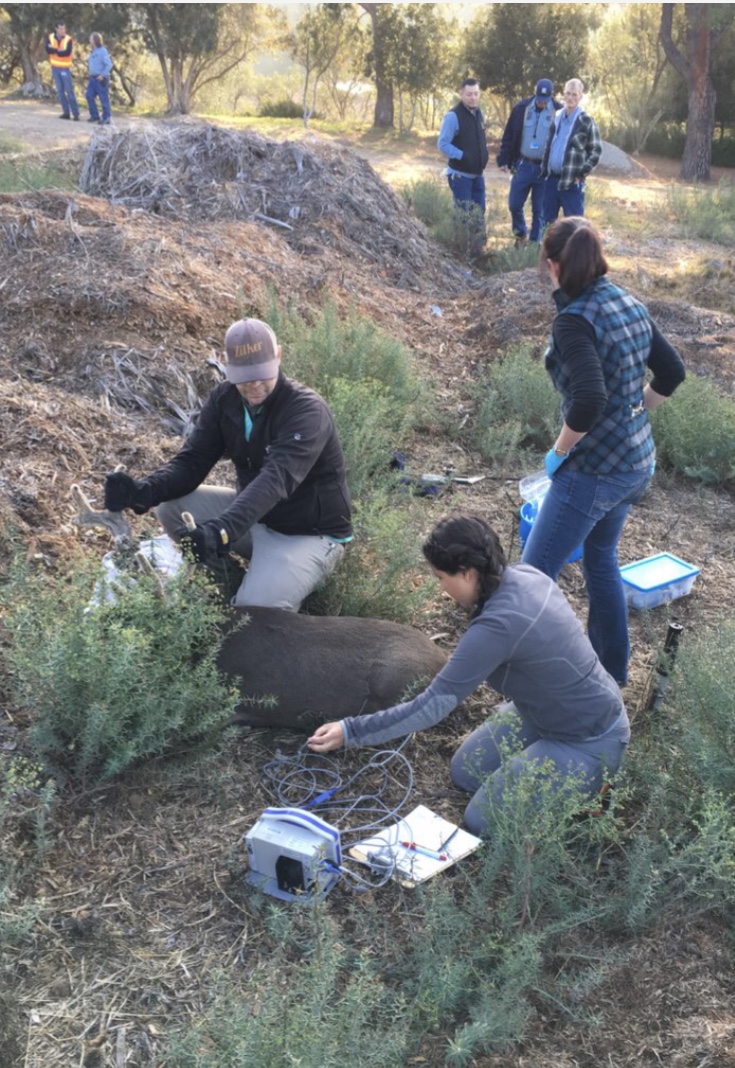
The deer was sedated so the pipe could be removed. Photo by Heather Henderson

The grounds crew quickly located the buck for us, and I was able to get into a position to successfully dart the animal. Our dart gun at CWC is a simple carbon dioxide-powered rifle (sort of a glorified blowpipe), and the darts are pressurized with air so that when the needle enters an animal’s skin, a rubber sleeve is pushed off small holes on the side of the needle, and the drugs are quickly injected right after impact. The Deer was darted in the hindquarters with a combination of sedatives, half of which were reversible, and the other half were short-acting. He trotted off a few meters after darting, but we were easily able to watch him as the sedation was taking effect. His close-knit herd stayed by his side the entire time until I approached. About 15 minutes after darting, the buck laid down, and we were able to safely approach him. We protected his eyes with lubrication, blindfolded him and placed cotton in his ears to decrease stress and make him less reactive. He was held in a safe position and his vital signs were monitored by Denys and Maria Jose Lopez Jara, a visiting veterinarian from Chile.
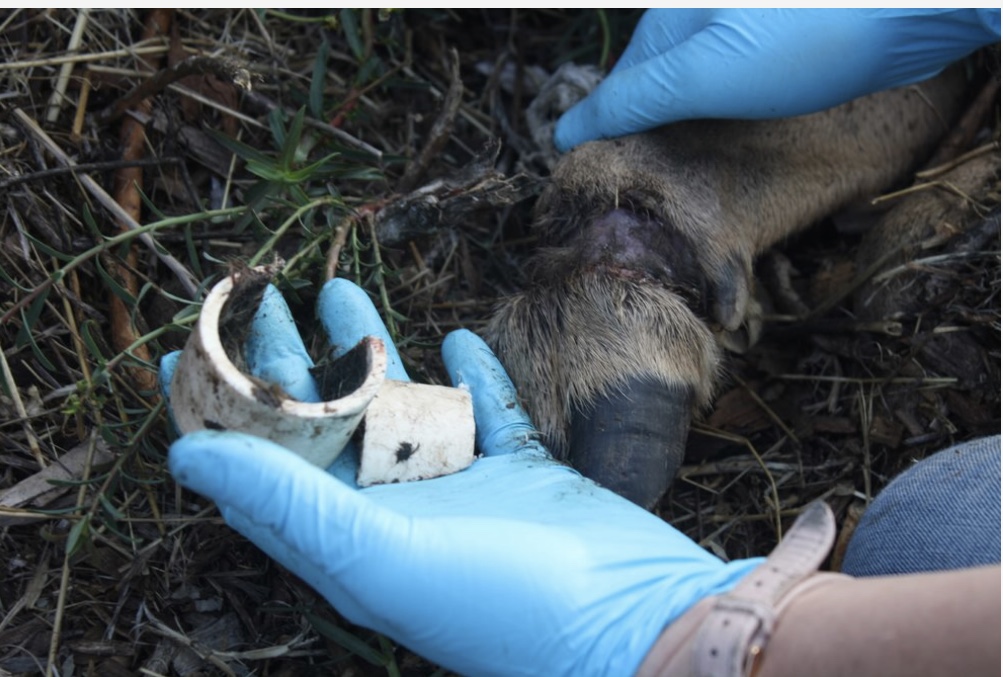
Staff was able to remove the restrictive pipe from the Deer’s leg. Photo by Stephany Lewis

The PVC pipe was quite tight around the Deer’s leg, around the pastern area, which is just above the hoof and below the fetlock joint. It has caused several large wounds on the leg around its entire circumference, but none so severe that we did not think he could recover once it was removed. Heather Henderson, our marine mammal stranding coordinator, removed the pipe with a coping saw, starting between the pipe and the leg and sawing outward to avoid causing further trauma. The wounds were clipped of dirty hair, cleaned, flushed, and an antiseptic ointment was applied. The buck then received an injection of a long-acting antibiotic, a pain medication, and reversal of the sedation.

It took just over a half hour after reversing the sedation for the buck to start to stand and walk on his own. While he was recovering, one of his herd-mates, a little doe, came to check on him! He spent most of the rest of the day relaxing with his herd, but has since been up and about, no longer in pain. We are still receiving updates from Brenda, and the buck is doing fabulously! We are so thrilled to have been able to help this animal, and hope this serves a reminder to everyone to please be neat and remove your trash!
https://cawildlife.org/wp-content/uploads/2026/05/CWClogo.png 0 0 protectanimals https://cawildlife.org/wp-content/uploads/2026/05/CWClogo.png protectanimals2018-12-14 23:23:142018-12-14 23:24:39Oh Deer! CWC Helps a Deer Impacted by Plastic Waste

The Lesson of the Lost Gull

August 14, 2018/1 Comment/in Uncategorized

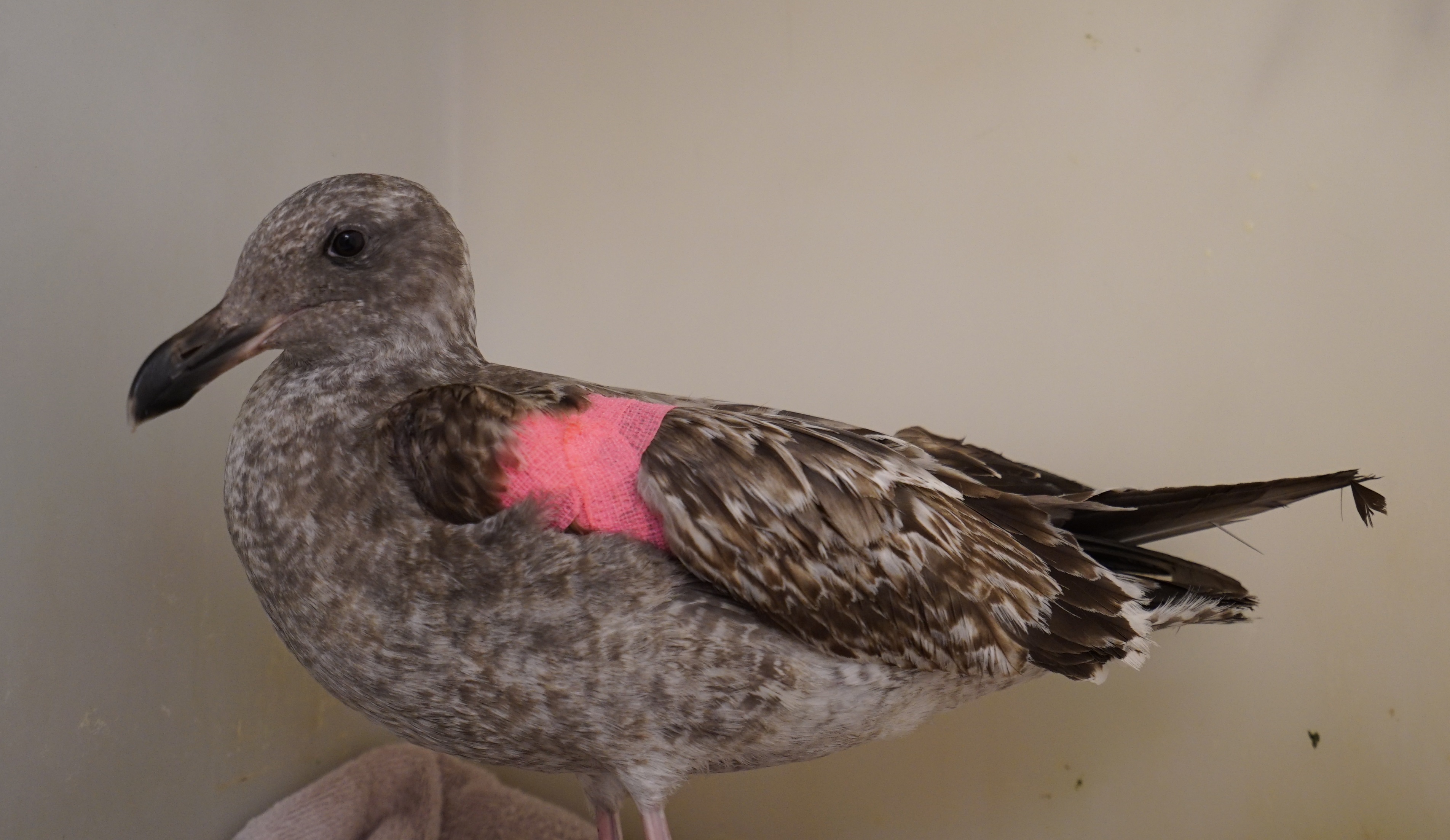
CWC cares for around 100 gulls every year. Photo by Jamie Pelayo

by Corby Sandberg, Volunteer

I was almost home from my volunteer shift at California Wildlife Center when, to my surprise, in the middle of a busy road in full-on five o’clock traffic, I saw a Gull walking around, seemingly lost. Instantly I pulled off the road, stopped my car, and ran over in an effort to keep the bird from being hit. I waved my hands to get him off the road, and he moved to the sidewalk, temporarily safe from the danger of passing cars.

One of my volunteer tasks at CWC is answering the phone and talking callers through this sort of situation. I request a photo of the animal to be texted to our hospital staff cell phone and, if they are a species we are authorized to treat, I ask the caller to bring it to us. I always tell people to try not to get too caught up in the animal’s predicament that they unwittingly place themselves in danger. So many variables, but protocol nonetheless. Now, I found myself following my own advice!

Waving all the traffic to go around me (thankfully, no one was honking at me), I observed this seemingly confused and docile creature. He was a beautiful bird, but sadly so very much out of his domain: high up above, circling round and round with its skymates, circling, circling…. I knew something had to be very wrong.

It’s best not to remove wild animals from their environment unless absolutely necessary. That’s another reason we ask people to call us before coming by. Every year, we see many young “rescues” brought to us by well-meaning members of the public. Inadvertently, they separate mothers from babies and, sadly, such rescues may spell doom. But, because of my CWC experience, this was clearly not the case. I keep a cardboard animal carrier and a towel for unfortunate events such as this and, after much observation and careful thought, wrapped the Gull in the towel and put him in the carrier. The bird remained docile and didn’t fight me at all. It seemed too easy.

I drove back to CWC, calling to let them know the deal. After I arrived, a kind technician took the bird from my carrier, weighed him, and examined the webbed feet, the wings. She showed me one wing in perfect condition, and then the other, which had been broken at some point, and not healed in a way that allowed for flight. The wing was crooked; this bird never would take to the sky again.

If the Gull had been brought to CWC immediately after its injury, then it is likely our vet could have set the break, allowing for a complete recovery, and then release…to enjoy the sky once again. The bird had showed absolutely no fear. Is it possible that someone rescued it after its accident and kept it–believing “I can save this bird”? And then, is it possible, after the break hardened and seemingly healed, just let it go?

This is my takeaway, the lesson this beautiful, tragic creature taught me: Do not keep wild animals at your house, thinking you can “save” them. Let professionals decide what the correct thing is to do–for the dignity and health of all creatures.

https://cawildlife.org/wp-content/uploads/2026/05/CWClogo.png 0 0 protectanimals https://cawildlife.org/wp-content/uploads/2026/05/CWClogo.png protectanimals2018-08-14 16:11:202018-08-14 16:11:20The Lesson of the Lost Gull

Marine Mammal Season Wrap Up

September 12, 2017/in Uncategorized

By Michael Remski, Marine Program Manager

Photo by Heather Henderson

Each winter, as we prepare for the upcoming marine mammal stranding season, it is impossible to accurately predict what the season will bring.  You plan for the worst, hope for the best, and try not to act surprised when things get crazy.  2017 brought us anomalies on all fronts.

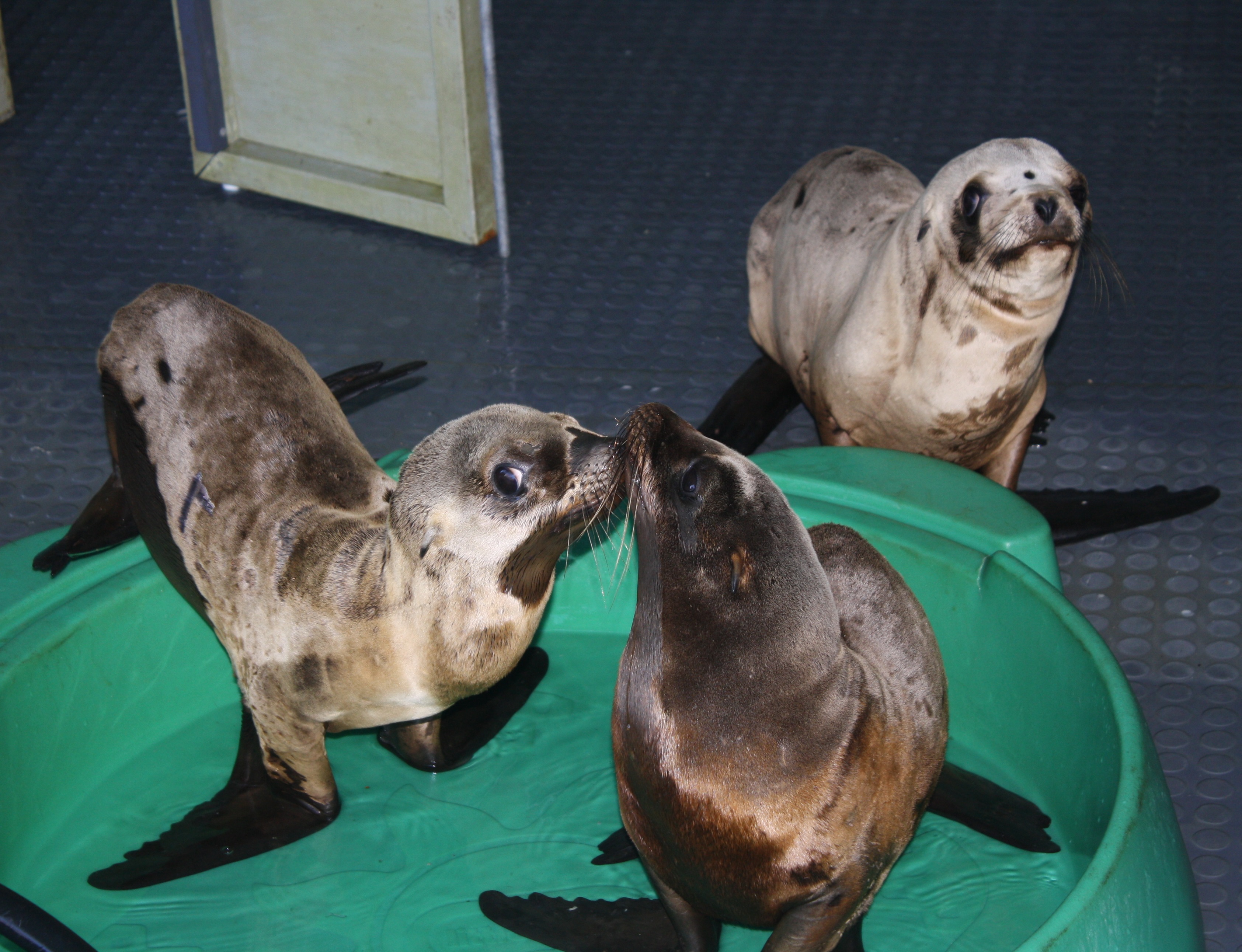
We opened as planned on January 1st and took in our first patient of the year.  The little sea lion turned out to be one of only 14 that would strand this year (our slowest sea lion pup season to date).

Then, just as we were ready to enjoy a relatively light year, the elephant seals started coming in, right on schedule in early March.  But unlike years past, they kept coming.  And coming.  And coming.  47 of them to date.  Fortunately, the rather large group of E-Seals turned out to be a little more robust than in years past, and we were able to save a record breaking 92% of them.

While still catching our breath from the rather busy elephant seal rush, we then got hit with one of the largest domoic acid outbreaks in years.  Dozens of adult California sea lions were coming ashore exhibiting the classic behaviors of head weaving, seizing and hauling out amongst the crowds on public beaches.  With local rehab centers at capacity, and a full load of elephant seal patients still back at CWC, the recent algal bloom took its toll on many California sea lions in the area.

Despite long hours and exhausting situations, the CWC staff and volunteers were able to rise to the occasion and do what we do best, save lives.  Congratulations and many thanks to all of you who have made this season a tremendous success.

https://cawildlife.org/wp-content/uploads/2026/05/CWClogo.png 0 0 protectanimals https://cawildlife.org/wp-content/uploads/2026/05/CWClogo.png protectanimals2017-09-12 15:24:342017-09-12 15:48:33Marine Mammal Season Wrap Up

American Coot Receives Surgery After Swallowing Fish Hook

May 31, 2017/in Uncategorized
Read more
https://cawildlife.org/wp-content/uploads/2026/05/CWClogo.png 0 0 protectanimals https://cawildlife.org/wp-content/uploads/2026/05/CWClogo.png protectanimals2017-05-31 22:12:312017-05-31 22:12:31American Coot Receives Surgery After Swallowing Fish Hook

Feeding Baby Birds

June 20, 2016/in Birds, Uncategorized

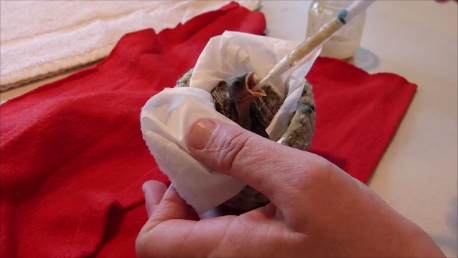
Click on the photo to see how baby birds at California Wildlife Center are fed.

Young songbirds need to be fed frequently with a syringe filled with a special baby bird formula.

Young songbirds need to be fed frequently with a syringe filled with a special baby bird formula.

https://cawildlife.org/wp-content/uploads/2026/05/CWClogo.png 0 0 protectanimals https://cawildlife.org/wp-content/uploads/2026/05/CWClogo.png protectanimals2016-06-20 19:43:362016-06-20 19:43:36Feeding Baby Birds

LATEST POSTS

  • The Education Corner: RenestingMay 13, 2026 - 11:40 am
  • Rescuing Stranded Marine Mammals during an Outbreak of Avian InfluenzaMay 13, 2026 - 11:38 am
  • Wild BeginningsMay 13, 2026 - 11:33 am
  • Through Darkness back to FlightMay 13, 2026 - 11:30 am

Contact Us

P.O. Box 2022
Malibu, CA 90265
E-mail: admin@cawildlife.org

Contact Us

P.O. Box 2022
Malibu, CA 90265
Hotline Phone: +1 310 458-WILD (9453)
E-mail: admin@cawildlife.org

DONATE TO CWC
CWC Tax ID#95-4580790

SIGN UP FOR OUR NEWSLETTER

CLICK HERE TO SIGN UP

Quick Links

Privacy Policy
Financials & Legal Info

Join us on Facebook!

Categories

BLOG ARCHIVES

© California Wildlife Center | All Rights Reserved | Webmaster SV3 Designs
  • Link to Facebook
  • Link to X
  • Link to Youtube
  • Link to Instagram
  • Link to Mail
Scroll to top Scroll to top Scroll to top

JOIN TODAY


Yes! Keep me updated about the animals at CWC

Enter your email address for the chance to win a private tour of CWC


    Your information will never be shared with a third party