
Oh Deer! CWC Helps a Deer Impacted by Plastic Waste
By Dr. Stephany Lewis, Veterinarian
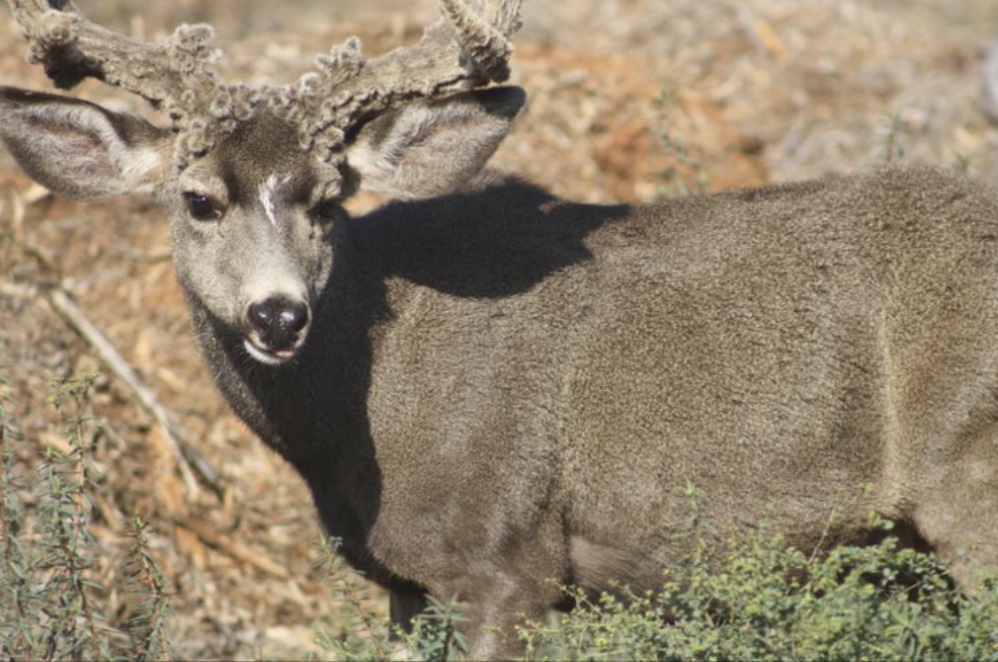
This Mule Deer buck had a plastic pipe stuck on his leg. Photo by Heather Henderson
This fall the California Wildlife Center was given a unique opportunity to help a Mule Deer buck who had gotten PVC piping entrapped on one of his legs. A caring citizen named Brenda Robinson contacted our hospital manager, Denys Hemen, regarding this buck in need of help. The buck spent much of his time with a herd at the Getty Villa, and a few days prior Brenda had noticed that the animal had gotten a piece of white PVC piping trapped just above his hoof. He was licking at the area and had begun to limp on the leg. Brenda was worried that this animal was in pain and would eventually be weakened to the point that he could fall prey to coyotes or mountain lions known to be in the area.
After learning of the situation, Denys and I visited with Brenda at the Getty Villa to observe the Deer and see if it would be feasible for us to help the animal. Brenda knew exactly where the herd would be throughout the morning, and he was so accustomed to her presence that we were able to observe him from a reasonable distance. We were excited to be able to potentially help this animal, and after organizing with biologist Amelia Viera at the California Fish and Wildlife Service, we were scheduled to return on the morning of October 30th to sedate the Deer and remove the plastic pipe from his leg.
The morning of October 30th, the group of us involved in the procedure as well as grounds crew at the Getty Villa, met just before sunrise to discuss the plan of action. Immobilizing an adult Deer in the field requires quite a bit of preparation, and it’s extremely important that everyone involved knows each step in the procedure, what to expect, what could go wrong, and what their responsibilities are.
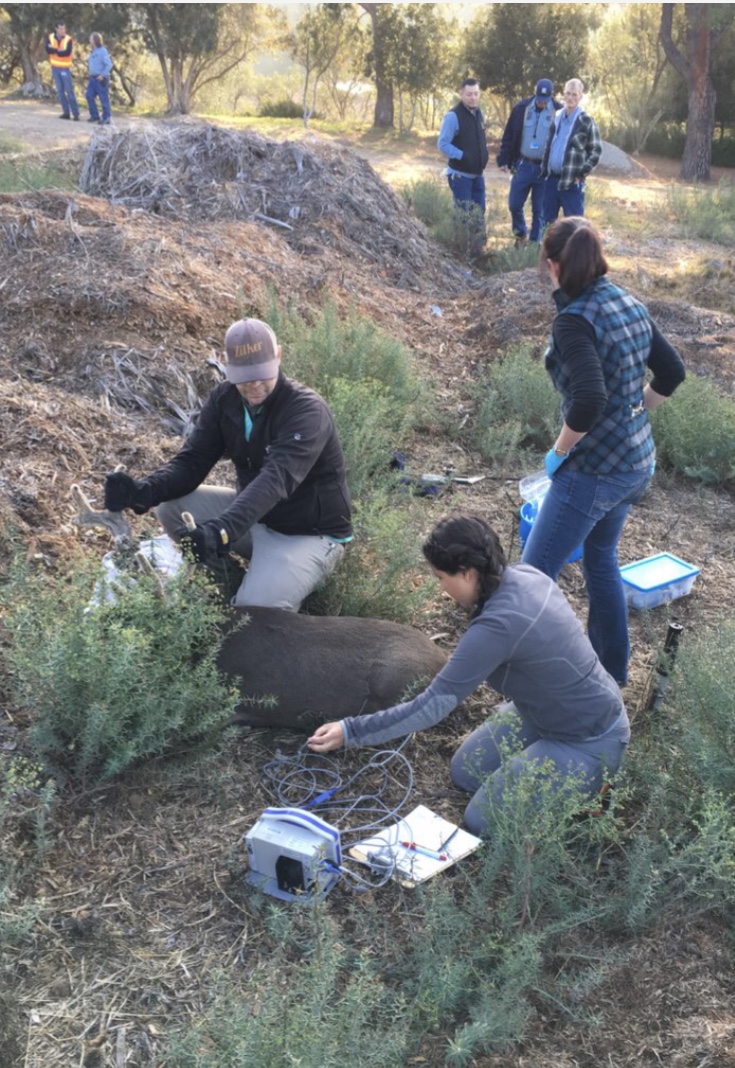
The deer was sedated so the pipe could be removed. Photo by Heather Henderson
The grounds crew quickly located the buck for us, and I was able to get into a position to successfully dart the animal. Our dart gun at CWC is a simple carbon dioxide-powered rifle (sort of a glorified blowpipe), and the darts are pressurized with air so that when the needle enters an animal’s skin, a rubber sleeve is pushed off small holes on the side of the needle, and the drugs are quickly injected right after impact. The Deer was darted in the hindquarters with a combination of sedatives, half of which were reversible, and the other half were short-acting. He trotted off a few meters after darting, but we were easily able to watch him as the sedation was taking effect. His close-knit herd stayed by his side the entire time until I approached. About 15 minutes after darting, the buck laid down, and we were able to safely approach him. We protected his eyes with lubrication, blindfolded him and placed cotton in his ears to decrease stress and make him less reactive. He was held in a safe position and his vital signs were monitored by Denys and Maria Jose Lopez Jara, a visiting veterinarian from Chile.
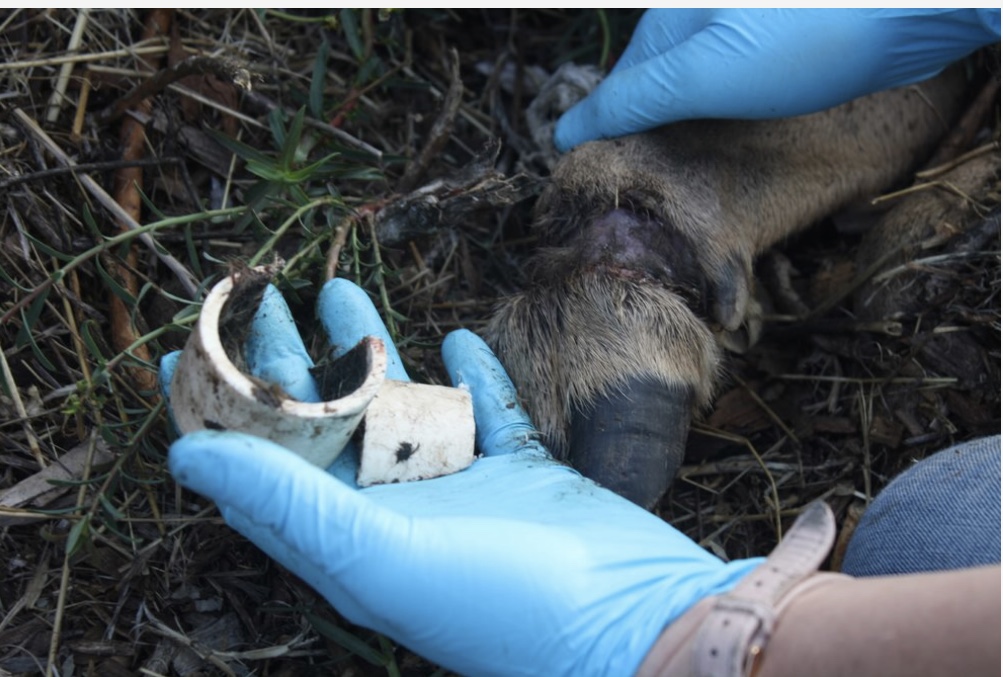
Staff was able to remove the restrictive pipe from the Deer’s leg. Photo by Stephany Lewis
The PVC pipe was quite tight around the Deer’s leg, around the pastern area, which is just above the hoof and below the fetlock joint. It has caused several large wounds on the leg around its entire circumference, but none so severe that we did not think he could recover once it was removed. Heather Henderson, our marine mammal stranding coordinator, removed the pipe with a coping saw, starting between the pipe and the leg and sawing outward to avoid causing further trauma. The wounds were clipped of dirty hair, cleaned, flushed, and an antiseptic ointment was applied. The buck then received an injection of a long-acting antibiotic, a pain medication, and reversal of the sedation.
It took just over a half hour after reversing the sedation for the buck to start to stand and walk on his own. While he was recovering, one of his herd-mates, a little doe, came to check on him! He spent most of the rest of the day relaxing with his herd, but has since been up and about, no longer in pain. We are still receiving updates from Brenda, and the buck is doing fabulously! We are so thrilled to have been able to help this animal, and hope this serves a reminder to everyone to please be neat and remove your trash!
so happy!!!
Thank you for your help in the aid of the mule deer great job and all so beautiful. Great ending I am excited! Laurie