• Link to Facebook
  • Link to X
  • Link to Youtube
  • Link to Instagram
  • Link to Mail
MEDICAL EMERGENCY? CALL: +1 310 458-WILD(9453)
DONATE
California Wildlife Center
  • Home
  • About Us
    • What We Do
    • Our Team
    • Education
  • Animal Resources
    • Medical Emergency
    • Co-Existing with Wildlife
    • FAQ
    • Animal Profiles
    • Gallery
  • Support Us
    • Ways to Support Us
      • Donate & Support Wildlife
      • Conservation Circle
      • Sponsor an Animal
      • Our Wish List
      • Other Ways to Give
  • Get Involved
    • Employment
    • Volunteer
      • Become a Volunteer
      • Internships
      • Externships
  • Events
  • News & Blog
    • In the News
    • Newsletters
    • Patient of the Week
    • Edison
    • From the Community
    • Videos
    • Gallery
    • Media Requests
  • Contact
  • Store
  • Click to open the search input field Click to open the search input field Search
  • Menu Menu

A Marine Rescue of a Different Color

September 6, 2016/1 Comment/in CWC, Marine mammals

by Jeff Hall, Marine Program Managerimage2crop

I’ve rescued hundreds….maybe even thousands of animals in my career.  From mountain lions and black bears to seals and dolphins, I’ve seen my fair share of different species and had a hand in their rescue.  Never in my career have I rescued a Green Sea Turtle, that is until earlier this month!

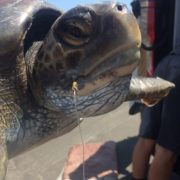
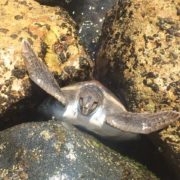
A man was fishing off a small rocky cliff at Topanga Beach in Malibu when he caught something on his line he wasn’t expecting.  Green sea turtles are normally warm-water-loving animals more comfortable in the oceans around Hawaii, or Central and South America.  California does have a healthy population of sea turtles, but we usually see Olive-Ridleys in these waters.  

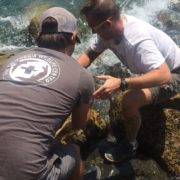
The green sea turtle was hooked by the fisherman’s pole and reeled into shore where the line broke and the turtle became wedged into some rocks.  As waves crashed around us, the rescue team from the California Wildlife Center and I hoisted the 28-pound turtle to our transport van and quickly took it to the Aquarium of the Pacific.  There, the hook was soon removed image4cropand the turtle was placedimage3 in a rehabilitation tank for recovery.  It should be released within a month.  

https://cawildlife.org/wp-content/uploads/2026/05/CWClogo.png 0 0 protectanimals https://cawildlife.org/wp-content/uploads/2026/05/CWClogo.png protectanimals2016-09-06 22:39:072016-09-06 22:40:15A Marine Rescue of a Different Color

Two Elephant Seals Released to Wild with Help of Coast Guard

July 15, 2016/in Community, Marine mammals
Read more
https://cawildlife.org/wp-content/uploads/2026/05/CWClogo.png 0 0 protectanimals https://cawildlife.org/wp-content/uploads/2026/05/CWClogo.png protectanimals2016-07-15 16:13:192016-07-15 20:10:29Two Elephant Seals Released to Wild with Help of Coast Guard

Fur Seals of Isla Guadalupe

July 5, 2016/in Marine mammals, Wildlife Medicine

By Staff Veterinarian, Dr. Lorraine Barbosa

This March, I had the amazing privilege of traveling to Isla Guadalupe, a small island off the coast of Baja Mexico, and the primary place in the world where the ESA-listed Guadalupe fur seal breeds. I traveled with a team of scientists from the Centro Interdisciplinario de Ciencias Marinas (CICIMAR-IPN), Sonoma State University, and The Marine Mammal Center, whose research topics included general health assessments, satellite tagging, investigation of environmental and handling stressors, and my project- anesthesia parameters.

Fur Seal Pup by Lorraine Barbosa

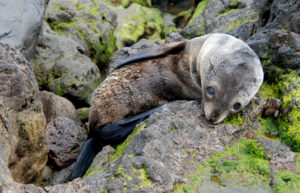
Guadalupe fur seals are on the Endangered Species Act list and considered threatened. Photo by Lorraine Barbosa

We traveled first by car to Ensenada, Baja California, Mexico, then by 22hr boat ride to the small volcanic island located 250mi into the vast desolation of the Pacific Ocean. Each morning we made a short trek to the fur seal rookery, a long rocky outcropping where waves whipped against the shores and tides ruled our daily routine. There, we were surrounded by the wailing cries of adult females arriving to the rookery from foraging trips, calling back and forth to their bleating pups until they reunited. The young pups whose mothers were away played and jughandled carefree in the tidepools, while the older pups, who for the most part were plump and healthy, sunned themselves on the rocks before heading off into the ocean on their own adventures.

We rotated between catching pups and adult females, overall anesthetizing 15 seals during our stay. Catching the pups was relatively simple: sneak up and grab them with a net while they slept. Catching the adult females took a bit more finesse. They were much more alert and skittish. One had to spend time sneaking up on them, taking small crouched steps forward each time they closed their eyes for just a moment, and pretending to be disinterested in them each time they opened their eyes to reassess our proximity. Once close enough, one had to quickly net the 55kg of unruly muscle and retain her until the others arrived to help. A face mask was then applied, and Isoflurane gas anesthesia was delivered until the seal slipped into unconsciousness. Once asleep, each researcher set out collecting samples for their various research projects. Meanwhile, I monitored heart rate, respiratory rate, and other vital parameters, ensuring the animal was maintained at a proper level of anesthesia. In the evenings we would assemble in our makeshift living room laboratory, all working together to process the day’s samples, until the electricity would go out at 10pm. The anesthesias progressed smoothly and quickly, and before we knew it, so had our time on the island. As we departed on our final day, the rookery again becoming engulfed by the sounds of the thrashing waves and the howling cries of the fur seals, I knew how lucky I was to have had such an incredible experience, and that I would do it all over again in a heartbeat.
All activities were conducted under permits (DGVS/00050/16) issued to Dr. Fernando Elorriaga Verplancken (CICIMAR-IPN) by the Mexico Secretaría del Medio Ambiente y Recursos Naturales (SEMARNAT) and Comisión Nacional de Áreas Naturales Protegidas (CONANP)-Reserva de la Biósfera Isla Guadalupe.


https://cawildlife.org/wp-content/uploads/2026/05/CWClogo.png 0 0 protectanimals https://cawildlife.org/wp-content/uploads/2026/05/CWClogo.png protectanimals2016-07-05 20:05:242016-07-05 20:05:42Fur Seals of Isla Guadalupe

Seal Survives Shark Strike

July 5, 2016/in Marine mammals, Wildlife Medicine

Northern Elephant Seal Receives Care
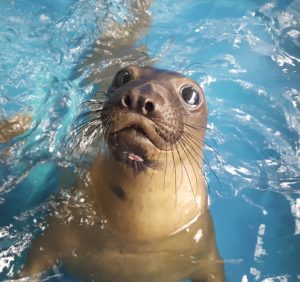
Elephant Seal After Rehab by Jeff Hall

After nearly two months of rehabilitation, this Northern elephant seal is ready for release! The injury to the chin caused by a cookiecutter shark has caused permanent scarring to the animal’s chin, but healing progressed well and he should have no lingering effects from the injury. Photo by Jeff Hall

By Marine Program Manager, Jeff Hal

Cookiecutter sharks sound like they’d be something really cute.  I draw images in my head of a rotund little shark, slowly marauding through the ocean with googly eyes, looking for cookie prey.  The reality is something not as lovable.  Cookiecutter sharks have round mouths ringed with teeth.  They will prey upon nearly any animal in the sea by latching onto skin of the animal and spinning, using their sharp teeth to remove a round piece of flesh.  The wound looks like it was made by a cookie cutter, hence the shark’s uniquely cute-sounding name.
1 Elephant Seal Before by Lorraine Barbosa

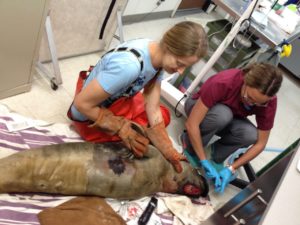
This Northern elephant seal was rescued by CWC’s Marine Department at La Costa Beach in Malibu with severe injuries to his chin and right side. Photo by Lorraine Barbosa

In April of this year, CWC’s Marine Department rescued an underweight Northern elephant seal pup from La Costa Beach in Malibu that was suffering from two cookiecutter shark wounds.  One was on the animal’s right side; the other was under his chin.  Both were significant, but the chin wound posed the greatest danger as jaw bone was exposed.

Marine Department staff and veterinarians worked daily to ensure the wound was kept clean, not an easy task for an animal that lies on his belly.  With constant cleaning (such as extra scrubbing of the enclosure flooring and letting the seal rest his head on clean towels), a course of antibiotics, numerous surgeries to debride the wound, and a few hundred pounds of fish, this Northern elephant seal was prepared to be returned to the wild!  On June 8, a team of CWC staff and volunteers helped carry his 154 pounds of blubber to the beach for release at Leo Carillo State Beach in Malibu!  Returning animals to the wild is always the most rewarding part of working and volunteering at CWC.

Saving an animal with cookiecutter shark wounds is just one of many examples of the hundreds of animals CWC’s Marine Department responds to each year.  To put it in perspective, in 2015, CWC responded to 568 reports of marine mammals stranded on the beach and rescued a total of 325 animals.  Of the 325 animals rescued, 138 were brought to CWC for rehabilitative care.  If a rescued animal is not taken to CWC’s marine mammal rehabilitation facility it is brought to other regional facilities such as the Marine Mammal Care Center at Fort MacArthur in San Pedro.

Luckily for marine mammals in the area, 2016 has been a somewhat slower season, but the Marine Department has still been responding to high numbers of stranded marine mammals.  In the first six months of 2016, CWC has responded to 331 reports of stranded marine mammals and rescued 208 of those animals.  Of the 208 rescued animals, 52 were brought to CWC for rehabilitative care.  Typically, CWC’s Marine Department sees an increase in rescues during the summer months because of increased human activity at the beaches.  There is also an increase in rescues of California sea lion pups which are born between May and July.  If something happens to a pup’s mother, or if the animal is weaned too early, they will need an organization like California Wildlife Center to help them along.

Whether it is caring for a California sea lion that was entangled in fish netting or rehabilitating a Northern elephant seal with textbook  cookiecutter shark wounds, CWC’s Marine Dept. staff and volunteers are doing our part to return sick and injured wildlife back to nature!

https://cawildlife.org/wp-content/uploads/2026/05/CWClogo.png 0 0 protectanimals https://cawildlife.org/wp-content/uploads/2026/05/CWClogo.png protectanimals2016-07-05 16:36:282016-07-05 19:50:53Seal Survives Shark Strike

Don’t Get Hooked

May 7, 2016/in Community, Marine mammals, Wildlife Medicine
Read more
https://cawildlife.org/wp-content/uploads/2016/05/15.3637-WEGU1a.jpg 2947 2477 protectanimals https://cawildlife.org/wp-content/uploads/2026/05/CWClogo.png protectanimals2016-05-07 02:01:132016-06-08 16:23:23Don’t Get Hooked

Return to the Pacific

March 8, 2016/in CWC, Marine mammals
Read more
https://cawildlife.org/wp-content/uploads/2016/06/back-of-boat.jpg 1200 1800 protectanimals https://cawildlife.org/wp-content/uploads/2026/05/CWClogo.png protectanimals2016-03-08 16:56:592016-06-08 17:01:36Return to the Pacific

4 Elephant Seal Pups Released Back Into Ocean After Weeks Of Rehabilitation

June 23, 2013/in Marine mammals, Wildlife Medicine
Read more
https://cawildlife.org/wp-content/uploads/2016/06/Connecting-with-Constituents-CA-Wildlife-Center.jpeg 450 600 protectanimals https://cawildlife.org/wp-content/uploads/2026/05/CWClogo.png protectanimals2013-06-23 17:09:392016-06-08 17:13:574 Elephant Seal Pups Released Back Into Ocean After Weeks Of Rehabilitation

Domoic Acid Cases hit Malibu

October 23, 2011/in CWC, Marine mammals
Read more
https://cawildlife.org/wp-content/uploads/2016/05/news_events_domoic_replace_280x115.jpg 115 280 protectanimals https://cawildlife.org/wp-content/uploads/2026/05/CWClogo.png protectanimals2011-10-23 19:41:162016-06-08 16:34:09Domoic Acid Cases hit Malibu
Page 5 of 512345

LATEST POSTS

  • The Education Corner: RenestingMay 13, 2026 - 11:40 am
  • Rescuing Stranded Marine Mammals during an Outbreak of Avian InfluenzaMay 13, 2026 - 11:38 am
  • Wild BeginningsMay 13, 2026 - 11:33 am
  • Through Darkness back to FlightMay 13, 2026 - 11:30 am

Contact Us

P.O. Box 2022
Malibu, CA 90265
E-mail: admin@cawildlife.org

Contact Us

P.O. Box 2022
Malibu, CA 90265
Hotline Phone: +1 310 458-WILD (9453)
E-mail: admin@cawildlife.org

DONATE TO CWC
CWC Tax ID#95-4580790

SIGN UP FOR OUR NEWSLETTER

CLICK HERE TO SIGN UP

Quick Links

Privacy Policy
Financials & Legal Info

Join us on Facebook!

Categories

BLOG ARCHIVES

© California Wildlife Center | All Rights Reserved | Webmaster SV3 Designs
  • Link to Facebook
  • Link to X
  • Link to Youtube
  • Link to Instagram
  • Link to Mail
Scroll to top Scroll to top Scroll to top

JOIN TODAY


Yes! Keep me updated about the animals at CWC

Enter your email address for the chance to win a private tour of CWC


    Your information will never be shared with a third party