
• Link to Facebook
  • Link to X
  • Link to Youtube
  • Link to Instagram
  • Link to Mail
MEDICAL EMERGENCY? CALL: +1 310 458-WILD(9453)
DONATE
California Wildlife Center
  • Home
  • About Us
    • What We Do
    • Our Team
    • Education
  • Animal Resources
    • Medical Emergency
    • Co-Existing with Wildlife
    • FAQ
    • Animal Profiles
    • Gallery
  • Support Us
    • Ways to Support Us
      • Donate & Support Wildlife
      • Conservation Circle
      • Sponsor an Animal
      • Our Wish List
      • Other Ways to Give
  • Get Involved
    • Employment
    • Volunteer
      • Become a Volunteer
      • Internships
      • Externships
  • Events
  • News & Blog
    • In the News
    • Newsletters
    • Patient of the Week
    • Edison
    • From the Community
    • Videos
    • Gallery
    • Media Requests
  • Contact
  • Store
  • Click to open the search input field Click to open the search input field Search
  • Menu Menu

A Mouse Tale

By Cori Carlson, Administrative Coordinator
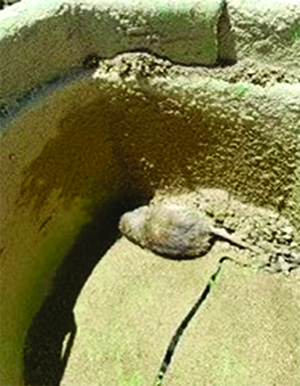
Pocket Mouse before being admitted to CWC

A Southern California Edison biologist brought a rare patient to California Wildlife Center (CWC) this March – a young native Pocket Mouse. This small mammal can be found in chaparral and grasslands from the San Francisco Bay area to Baja California. Brownish gray in color with white bellies, large ears and hind feet, the mouse has a distinctive fur-tipped tail. The juvenile Pocket Mouse admitted to CWC arrived thin, hypothermic, and with dried mud caked on her feet and tail. She also had an old tail amputation, which was possibly caused by a predator. The amputation had healed on its own and didn’t seem to cause any challenges.

After examining the patient, our wildlife technicians gave her fluids and placed a heating pad in her enclosure to help raise her temperature. Once she was stabilized the Pocket Mouse started eating and gaining weight.

Patient in her enclosure

Pocket Mouse storing seeds in her cheeks

The tiny mammals are most active at night and have fur-lined pouches in their cheeks to store food as they forage. They eat seeds and grasses, sometimes adding leafy vegetation or insects. They get water from the seeds they eat. To mimic her diet, our patient was offered grass and dove seed. The seeds were clearly her favorite. She filled up her cheeks and then stored them for later all around her enclosure.

The native Pocket Mouse is a solitary mammal who remains in burrows during the day, blocking the entrances with dirt to keep it cool and humid. At night the mice forage until their cheek pockets are full and then return home to hide their food along the passageways of their burrow.

Trying to provide our patient with an environment as close to her home in the wild, our technicians picked miner’s lettuce on site and found that when they put some in the mouse’s enclosure with the roots and dirt attached, she got very excited and ran around and around through the grass.

After about 10 days in care, this native Pocket Mouse was ready to be released. Our rescuer generously offered to take her back to her wild home in Castaic.

LATEST POSTS

  • The Education Corner: RenestingMay 13, 2026 - 11:40 am
  • Rescuing Stranded Marine Mammals during an Outbreak of Avian InfluenzaMay 13, 2026 - 11:38 am
  • Wild BeginningsMay 13, 2026 - 11:33 am
  • Through Darkness back to FlightMay 13, 2026 - 11:30 am

Contact Us

P.O. Box 2022
Malibu, CA 90265
E-mail: admin@cawildlife.org

Contact Us

P.O. Box 2022
Malibu, CA 90265
Hotline Phone: +1 310 458-WILD (9453)
E-mail: admin@cawildlife.org

DONATE TO CWC
CWC Tax ID#95-4580790

SIGN UP FOR OUR NEWSLETTER

CLICK HERE TO SIGN UP

Quick Links

Privacy Policy
Financials & Legal Info

Join us on Facebook!

Categories

BLOG ARCHIVES

© California Wildlife Center | All Rights Reserved | Webmaster SV3 Designs
  • Link to Facebook
  • Link to X
  • Link to Youtube
  • Link to Instagram
  • Link to Mail
Link to: Feather Imping Link to: Feather Imping Feather Imping Link to: The Secretive Pacific Harbor Seal Link to: The Secretive Pacific Harbor Seal The Secretive Pacific Harbor Seal
Scroll to top Scroll to top Scroll to top

JOIN TODAY


Yes! Keep me updated about the animals at CWC

Enter your email address for the chance to win a private tour of CWC


    Your information will never be shared with a third party